




An attack surface is the set of points where an attacker could gain access, manipulate information or trigger an unauthorized action. Agentic commerce expands that surface by allowing AI agents to search for products, call tools, make decisions and initiate purchases on a customer’s behalf. Each added identity, data source and permission creates another potential point of compromise, often before a payment reaches checkout.
For financial institutions, securing agent-mediated payments means looking beyond the person, device and payment credential. Controls must also verify the agent, define what it is allowed to do and check that the final transaction matches the customer’s intent. This entry maps the main exposure points, explains where established fraud controls may fall short and outlines safeguards across the journey, from agent enrollment and consent to payment authorization, settlement and dispute handling.
Key takeaways: how agentic commerce expands potential attack surfaces
- Agentic commerce adds software identities, delegated authority, tool calls and machine-to-machine interactions to the payment risk model.
- Prompt injection can alter an agent’s behavior before a payment instruction reaches the control layer.
- Payment security must validate the agent, the customer’s intent, transaction scope and final execution.
- Financial institutions need traceable decisions, least-privilege access, scoped credentials and independent checks for high-risk actions.
- Entersekt connects context-aware authentication with real-time risk decisioning across banking and payment journeys.
What is the attack surface in agentic commerce?
The attack surface in agentic commerce is the set of identities, interfaces, data stores, decisions and payment steps that an attacker could influence. It includes the customer, the AI agent, the model, memory, external content, tools, merchant systems, payment credentials and financial institution controls.
A conventional online purchase usually centers on a person, a device, a merchant and a payment credential. A purchase made through agentic commerce adds delegation. The customer may authorize an agent to act under conditions such as product type, merchant, price range, timing or recurring permission. Those conditions become security-relevant data.
The key change is the separation between intent formation and transaction execution. A customer may express a broad goal, while an agent selects a merchant, product, delivery option and payment route. Security controls must establish that the final action still matches the original authority.
Which new attack surfaces does agentic commerce create?
Agent identity and registration
Risk: Attackers may impersonate an approved agent, steal its credentials or register a malicious one. A user-agent string or network address alone does not establish trust.
Key controls: Use verifiable credentials, signed requests and registered keys. Link each agent to its operator and the customer authority behind the transaction, and distinguish approved activity from malicious automation.
Delegated authority and user intent
Risk: Broad permission can be interpreted too loosely. Malicious instructions or altered product information may push an agent beyond the customer’s intended scope.
Key controls: Define what the agent may do, for whom, for how long, under which conditions and at what value. Check the final payment against that mandate. Verifiable intent provides cryptographic evidence of what the customer authorized, helping systems verify that the action stayed within scope.
Prompts, external content and agent memory
Risk: Instructions hidden in websites, product feeds, messages or documents can redirect an agent, expose data or trigger unauthorized tool calls. Poisoned memory may carry that influence into later sessions.
Key controls: Treat external content as untrusted input. Separate short-lived task context from durable customer preferences, and validate stored data before it affects a high-impact action.
Tools, APIs and model context protocols
Risk: Tools let agents retrieve balances, add beneficiaries, change limits, place orders or submit payments. Excessive permissions can turn a limited compromise into account takeover or unauthorized funds movement.
Key controls: Give each tool a narrow purpose, defined inputs, an explicit authorization policy and a recorded result. Separate read and write permissions, and independently check high-impact actions.
Payment credentials and transaction execution
Risk: A credential may be reused or applied outside its intended scope. Merchant, amount or recurring terms may change after the customer approves the original request.
Key controls: Use tokenization, scoped credentials, transaction limits and transaction-specific approval. Preserve the link between the customer instruction, agent decision and final authorization message.
Why do existing fraud controls need to change?
Many fraud models are optimized around human behavior at login or checkout. Agentic commerce introduces machine-speed activity, repeated decision cycles and interactions that may look unusual even when authorized. The important signal may be the agent’s authority and behavior across a journey, rather than a single session.
Authentication also changes position in the flow. A customer may authenticate an agent, approve a mandate or confirm a payment instruction before checkout. A separate transaction decision may still be necessary when risk changes. Identity confirms who is present; intent validation confirms what that party is allowed to do.
Watch our on-demand webinar, Demystifying agentic banking: Who gave the agent permission, and is it still true?, for a discussion of delegated authority, ongoing consent and the distinction between a valid mandate and customer authentication.
For financial institutions, this means connecting identity, device, behavioral, transaction and payment signals across channels. Entersekt’s digital banking fraud prevention approach illustrates why context matters across account access and high-risk transactions.
How can financial institutions reduce agentic commerce risk?
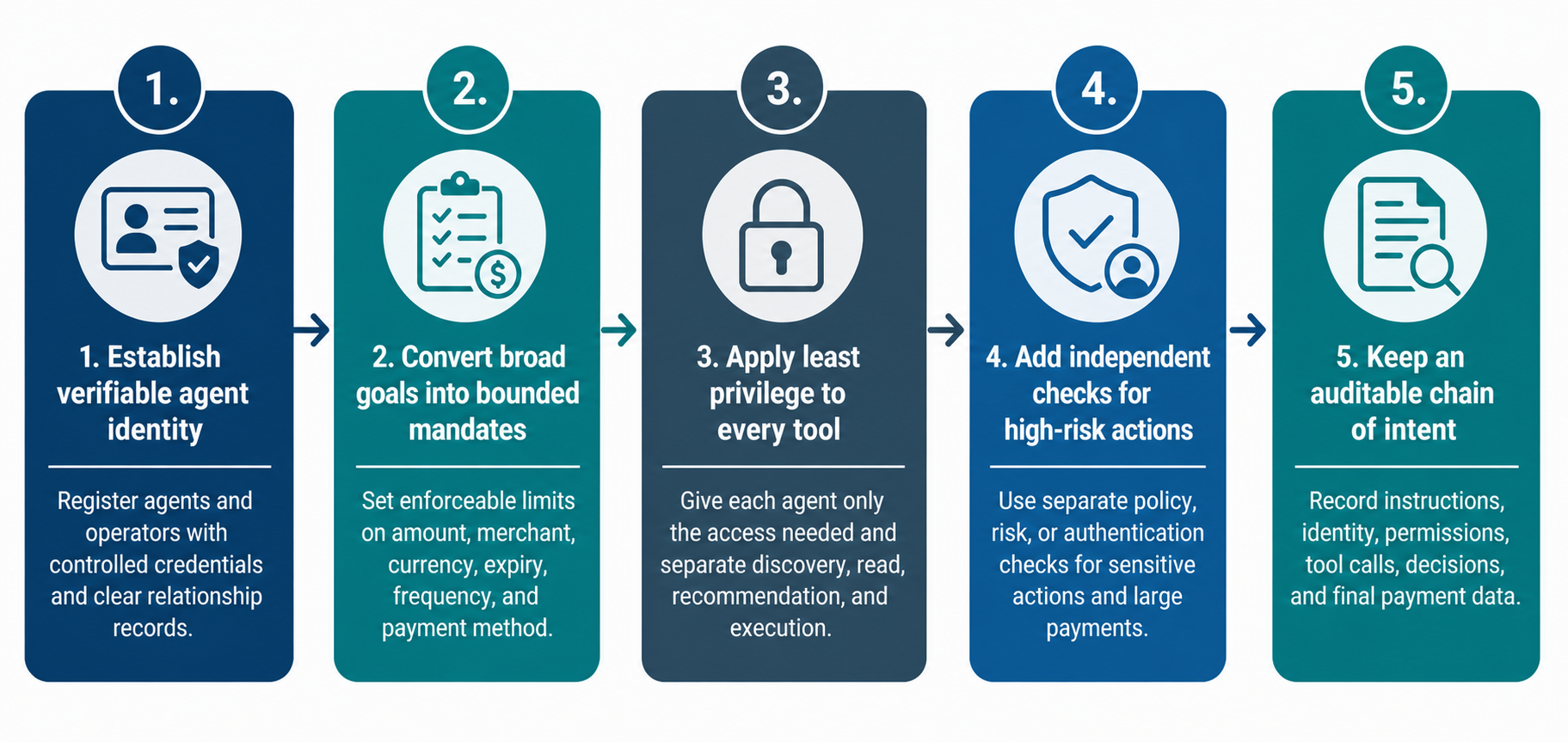
Phishing-resistant methods can help bind approval to the intended transaction. Entersekt’s phishing-resistant authentication resources describe device identity, passkeys, biometrics and risk-aware authentication options that can support this model.
What role do payment networks and standards play?
Payment networks are developing agent-specific controls that address agent recognition, consumer intent, tokenization and transaction visibility. Visa describes agent-specific payment tokens and authenticated payment instructions, while Mastercard describes agentic tokens and registered agents as part of its Agent Pay work.
These mechanisms can help, but a network token does not answer every security question. Institutions still need to assess agent behavior, customer authority, merchant risk, account context and changes between instruction and execution.
For a deeper explanation of credential protection versus customer authentication, read the Glenbrook Partners white paper, Tokenization and 3-D Secure: Complementary Components of Modern Risk Management.
The International Monetary Fund describes agentic payments through three layers: intent formation and orchestration, authorization and control, and settlement. This separation is useful because each layer has different owners, evidence and failure modes. Read the IMF note on agentic AI and payments for the wider policy and architecture context.
How does agentic commerce affect digital banking and card payments?
In digital banking, an agent may help a customer move money, manage bills, open an account or change account settings. The highest risk may arise before the transfer itself, such as when a new payee is added or a device is enrolled. Controls should assess the full sequence, not only the final payment.
In card payments, an agent may discover products, select an offer and submit a purchase. 3-D Secure can remain part of the payment authentication decision, but the surrounding evidence must show who instructed the agent and what the agent was authorized to do. Entersekt’s 3-D Secure payments capabilities are relevant to issuer, merchant and processor controls across that journey.
Device and browser signals can add context when an agent interacts with a financial service. Entersekt’s device identity resource explains how a registered device can act as a possession signal alongside other authentication factors. That signal should support a broader decision and should not be treated as proof of customer intent by itself.
Our blog, All things in moderation: Why fraud protection requires more than one signal, explains why device, behavioral, identity and transaction signals need to inform a coordinated risk decision.
What should a risk assessment cover?
| Risk area | Questions to answer | Useful controls |
|---|---|---|
| Identity | Who is the agent, operator and customer? | Verifiable credentials, registration, key rotation |
| Authority | What may the agent do, and when does permission expire? | Scoped mandates, limits, expiry and revocation |
| Intent | Does the final action match the customer’s instruction? | Instruction binding, transaction signing and policy checks |
| Execution | What tools, APIs and credentials did the agent use? | Least privilege, isolation, validation and audit logs |
| Behavior | Is activity consistent with the expected agent and account? | Risk intelligence, behavioral analysis and step-up review |
| Accountability | Can the institution reconstruct and explain the decision? | Traceable events, evidence retention and dispute workflows |
What is the practical security principle?
1. Authenticate the actor
Who is making the request?
2. Authorize the delegation
What is the agent permitted to do?
3. Validate the intent
Does the action match the customer’s instruction?
4. Monitor the execution
Does activity stay within the approved scope?
OWASP’s AI Agent Security Cheat Sheet identifies risks such as prompt injection, tool abuse, memory poisoning, excessive autonomy, data exposure and cascading failures. These risks reinforce the need for controls across the full agent lifecycle.
FAQs about how agentic commerce expands the attack surface
➡️ What is agentic commerce?
Agentic commerce is commerce in which software agents discover, compare or purchase products and services on a customer’s behalf. The agent can interpret goals and perform multiple steps, so security must cover delegation, intent, tool access and payment execution. Entersekt connects authentication and risk decisioning across banking and payment journeys.
➡️ Why does agentic commerce expand the attack surface?
Agentic commerce expands the attack surface because each agent identity, data source, memory store, tool, API and payment step can be attacked or misconfigured. A compromise may alter a recommendation before the payment stage. Entersekt’s context-aware authentication helps add risk signals across high-value interactions.
➡️ Can authentication alone secure agentic payments?
Authentication alone cannot secure agentic payments because confirming an identity does not confirm the scope or intent of an agent’s action. Payment controls also need authorization limits, transaction binding, tool permissions and audit evidence. Entersekt supports risk-aware authentication for sensitive banking and payment interactions.
➡️ What should an AI agent be allowed to do?
An AI agent should receive only the permissions required for its stated task, with limits on value, merchant, data, timing and frequency. High-impact actions should require an independent policy check or customer approval. Entersekt’s device identity and authentication capabilities can add context to these decisions.
➡️ How should banks prepare for agentic commerce?
Banks should map the full agent lifecycle, register trusted agents, define delegated authority, restrict tools, bind payment instructions to customer intent and retain an auditable record. They should also test prompt injection, credential theft and abnormal agent behavior. Entersekt helps banks connect authentication, device and transaction context across channels.
➡️ Is agentic commerce already a regulatory issue?
Agentic commerce is already a governance issue because institutions must address authorization, traceability, privacy, operational resilience, fraud liability and customer protection. Specific obligations vary by jurisdiction and use case. Institutions should assess agent deployments against applicable payment, data protection, cybersecurity and outsourcing requirements.