








Verifiable intent is a way to create cryptographic evidence of what a person authorized an AI agent to do. In agentic commerce, an agent may search, choose and pay on a person’s behalf. Verifiable intent links the person’s authenticated instruction to the resulting action, giving consumers, merchants and issuers a shared basis for trust.
For financial institutions, the subject connects directly to verifiable intent, transaction authentication and fraud decisioning. It addresses a gap that ordinary session authentication cannot close: proving who signed in does not, by itself, prove which purchase, transfer or data-sharing action that person approved.
What is verifiable intent?
Verifiable intent is a cryptographically protected record that represents a user’s authorization for a specific action or set of constraints. It can bind together the authenticated person, the instructions given to an agent, the relevant transaction details and the resulting authorization.
The concept is emerging in response to agentic payments, where software can act after the person has left the checkout experience. The person might authorize an agent to buy a particular product, stay below a spending limit or reorder a service on defined terms. The agent then operates under that authority.
Verifiable intent does not mean that every payment must be approved manually at the moment it occurs. It means the authorization is represented in a form that participating systems can verify, interpret and audit.
Why does verifiable intent matter?
Verifiable intent matters because agentic payments separate the moment of instruction from the moment of execution. That separation creates questions that existing payment and identity controls were not designed to answer on their own.
- What did the person authorize? The record should describe the instruction, transaction or constraints that define the permitted action.
- Who authorized it? The authorization should connect to an authenticated person or account.
- Did the agent stay inside its authority? The final action should be checked against the approved terms.
- Can the parties verify the evidence later? Merchants, issuers and dispute teams need an auditable account of what happened.
These questions matter for fraud prevention as well as customer experience. A valid login can still precede a scam payment if a customer has been manipulated into approving an action they do not understand. Verifiable intent adds transaction meaning to the identity signal.
How does verifiable intent work?
Verifiable intent generally follows a chain from instruction to authorization to execution. The precise technical format will depend on the protocol and implementation, but the trust model has several consistent parts.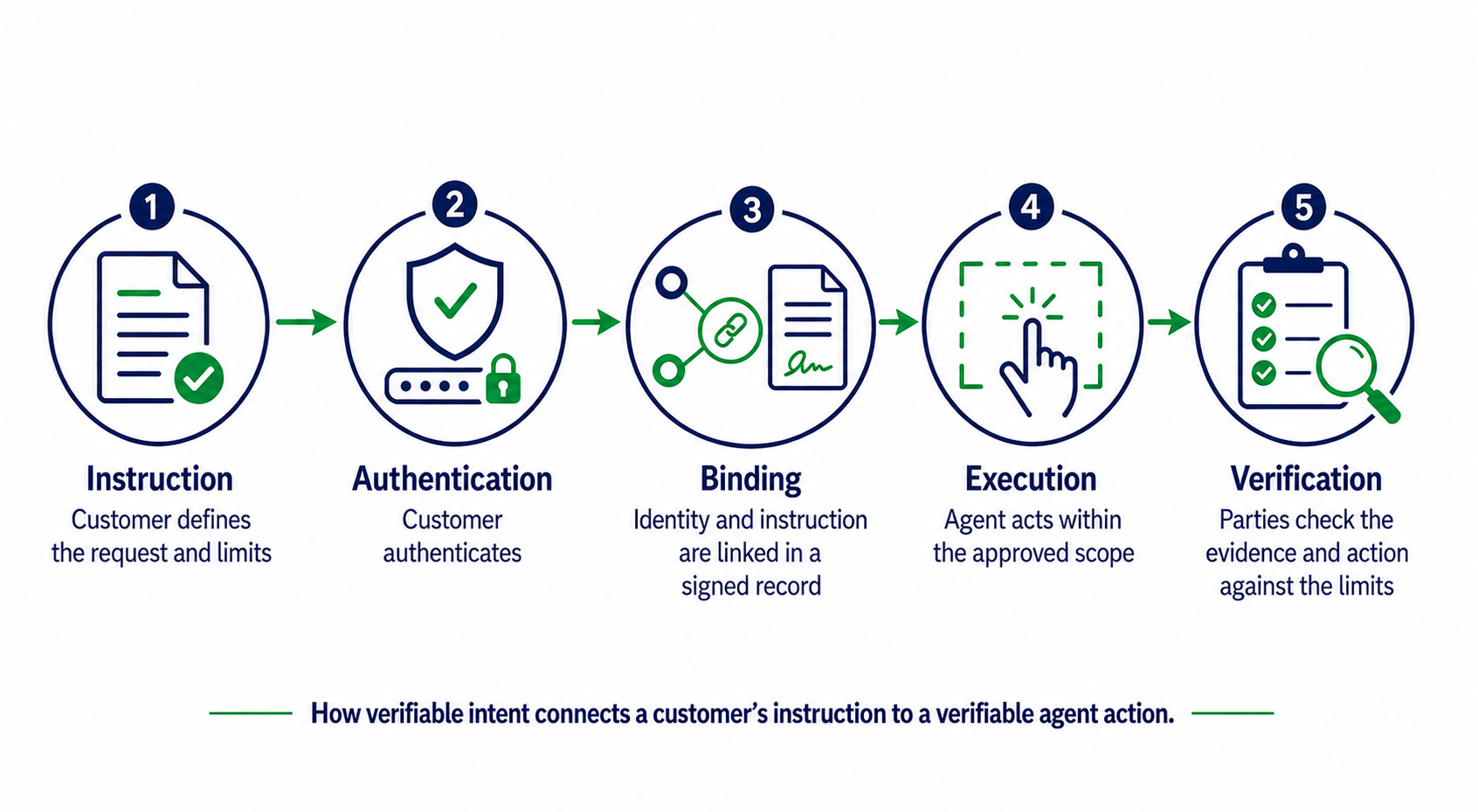
- Instruction: A person gives an agent a request or defines constraints, such as a merchant, product, amount, destination or expiry.
- Authentication: A trusted authenticator establishes that the person is authorized to issue the instruction. FIDO authentication and passkeys can support this step.
- Binding: Cryptographic data binds the authenticated identity and the instruction to a signed authorization record.
- Execution: The agent acts within the approved scope, potentially after receiving updated information from a merchant or payment provider.
- Verification: Relevant parties validate the record, confirm that the action remains inside the approved parameters and retain evidence for audit or dispute handling.
The record can also support privacy controls. A verifier may need to confirm that an agent is authorized and that a payment falls within a limit, while having no need to see the person’s full instruction history. Selective disclosure approaches can reduce unnecessary sharing of personal or commercial information.
Verifiable intent and transaction confirmation
Verifiable intent builds on an established security principle: authentication should be connected to the action being approved. The FIDO Alliance describes transaction confirmation as collecting consent for a specific action, such as a payment, transfer or data disclosure, and preserving evidence that the person saw and agreed to those details.
Transaction confirmation usually concerns a particular action presented to the person. Verifiable intent extends the same logic to delegated authority. It can represent instructions that an agent follows later, including conditions that define what the agent may and may not do.
This distinction is important for banking. A passkey can help prove control of an account or device. A signed transaction confirmation can help prove approval of a particular payment. Verifiable intent can help show that an autonomous action was authorized under defined instructions.
What is the difference between identity, authentication, authorization and intent?
Identity, authentication, authorization and intent describe different questions in a trust decision.
| Concept | Question it answers | Example in agentic payments |
|---|---|---|
| Identity | Who is the person or organization? | The account is associated with a verified customer. |
| Authentication | How can the system verify control of that identity? | The customer authenticates with a passkey or another approved method. |
| Authorization | What action is the authenticated party allowed to perform? | The customer permits an agent to make purchases up to a defined limit. |
| Intent | What did the person mean to authorize? | The agent buys a specified item from an approved merchant under stated conditions. |
These signals work together, but they are not interchangeable. A financial institution should avoid treating successful authentication as proof that every later action is appropriate. Context, transaction details and the customer’s stated authority still matter.
How does verifiable intent support fraud prevention?
Verifiable intent supports fraud prevention by giving risk systems more context about the authorized action. A decision can consider the person, the agent, the merchant, the payment details, the device or channel and the constraints attached to the instruction.
This context can help identify actions that fall outside the customer’s authority. Examples include an amount above the approved limit, a different merchant, a new beneficiary, an expired mandate or a material change to the checkout details.
It does not replace risk analysis. An attacker may compromise an account, manipulate an agent or induce a person to issue a harmful instruction. Financial institutions still need device intelligence, behavioral signals, transaction monitoring and adaptive authentication. Entersekt’s Context Aware Authentication illustrates the broader principle of assessing the full interaction rather than relying on one credential event.
What does verifiable intent mean for banks and payment providers?
For banks and payment providers, verifiable intent introduces a new trust object that can sit alongside identity, payment and risk data. It may help issuers distinguish an authorized agent action from an unauthorized request, while giving merchants a clearer basis for accepting delegated payments.
Implementation decisions will include the trust relationships between people, agents, merchants, payment providers and issuers. Institutions will also need policies for mandate scope, expiry, revocation, replay protection, dispute handling and data minimization.
Payment standards remain important. EMV 3-D Secure helps issuers and merchants exchange transaction, payment and device data for card-not-present authentication. Verifiable intent addresses a related but different question: what authority did the person give an agent before the payment was attempted?
Human-present and human-not-present agentic payments
Agentic payment models can differ according to whether the person is present when the final action is approved. In a human-present transaction, an agent prepares the purchase and a person reviews and approves the final details. In a human-not-present transaction, the person authorizes constraints in advance and the agent acts later.
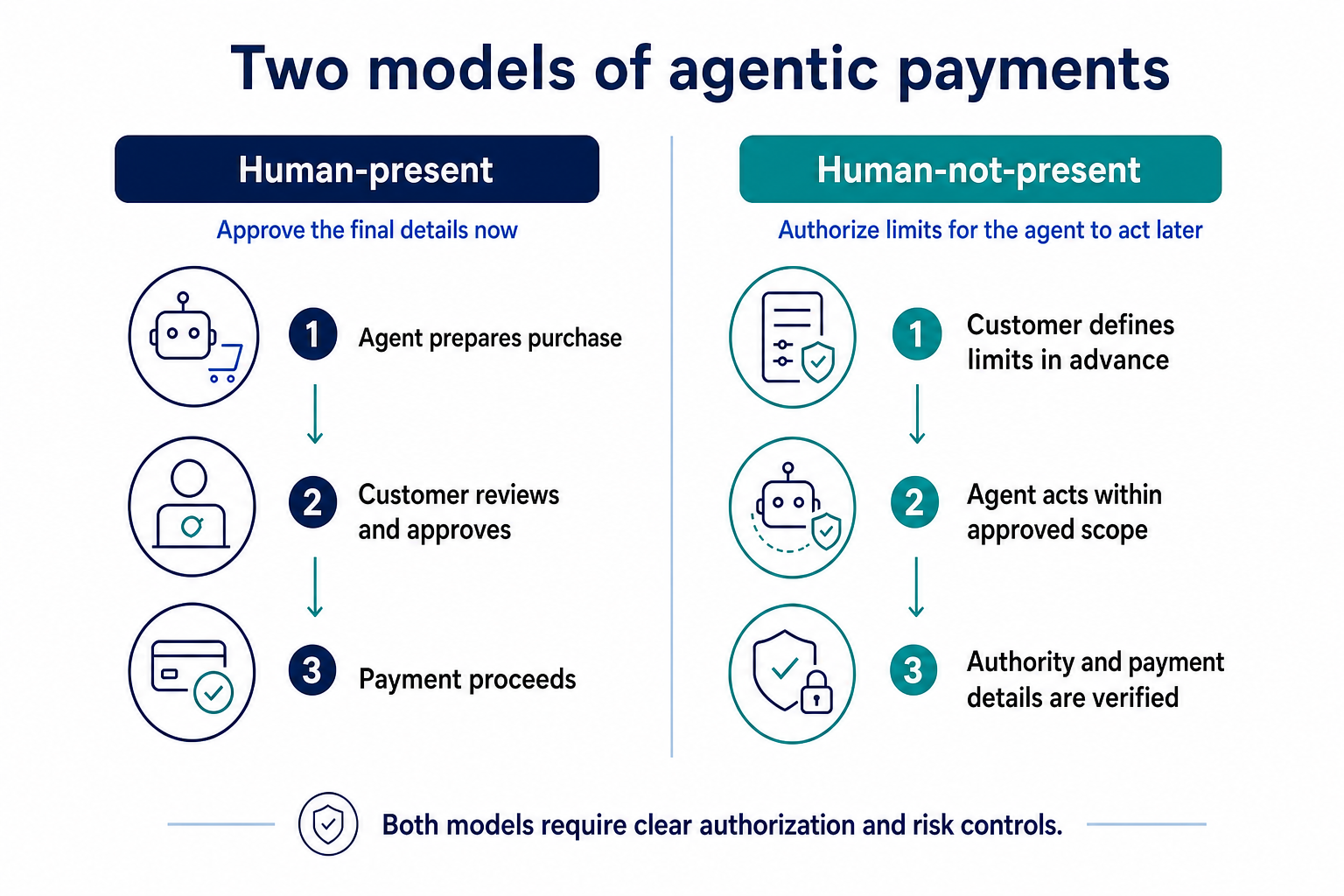
Entersekt’s Human-Present Transactions entry explains the first model and its relationship to trusted authentication surfaces. Verifiable intent is especially relevant to the second model because the evidence must represent delegated authority that remains meaningful after the original instruction.
What are the implementation challenges?
Verifiable intent is an emerging area, so institutions should treat interoperability, governance and assurance as design priorities. A cryptographic record is useful only when the parties that rely on it agree on how to issue, validate, revoke and interpret it.
- Interoperability: Agents, merchants, payment providers and issuers need compatible protocols and message formats.
- Authority boundaries: Instructions should express limits that systems can evaluate consistently.
- Revocation: People need a way to withdraw authority before an agent acts.
- Privacy: Participants should receive only the information needed for their decision.
- Accountability: Systems need reliable evidence for disputes, investigations and regulatory review.
- Risk adaptation: High-risk changes or unusual behavior may require additional authentication or human review.
Standards work is developing across the ecosystem. Mastercard describes Verifiable Intent as an open, standards-based trust layer co-developed with Google. Google has also described the Agent Payments Protocol as a foundation for agentic payments and noted that it is being contributed to the FIDO Alliance. These initiatives should be treated as evolving industry work rather than a settled universal standard.
What is the future of verifiable intent?
Verifiable intent is likely to become more important as software agents move from product discovery into payments, account servicing and other regulated actions. The central requirement will remain stable: delegated automation must be bounded by clear authority and backed by evidence that other parties can verify.
For financial institutions, the practical lesson is to connect authentication, authorization and transaction context. Entersekt’s digital banking fraud prevention approach reflects this direction by assessing risk across the customer journey and protecting high-risk actions after login.
Verifiable intent will not make every agentic transaction safe by itself. It can, however, give the ecosystem a clearer foundation for trust, accountability and dispute resolution as AI systems gain permission to act with real money.
FAQs about verifiable intent
➡️ Is verifiable intent the same as authentication?
No. Authentication helps establish who controls an identity, while verifiable intent records what that person authorized an agent to do. Entersekt connects authentication with transaction context so a security decision can account for both the actor and the action.
➡️ Can verifiable intent prevent payment fraud?
Verifiable intent can support fraud prevention by making authorized instructions and transaction constraints available for validation. It does not replace risk analysis. Entersekt combines contextual signals, device intelligence and adaptive authentication to assess whether a transaction is appropriate.
➡️ Does verifiable intent require a person to approve every payment?
No. A person can authorize an agent to act under defined conditions. Entersekt supports the broader move toward authentication that can be active or silent according to risk, channel and user preference.
➡️ How does verifiable intent protect privacy?
Verifiable intent can support selective disclosure, allowing a verifier to confirm a narrow fact without receiving the full instruction record. Institutions should still define data minimization, retention and access policies before deployment.
➡️ What should a bank evaluate before adopting verifiable intent?
A bank should assess protocol maturity, cryptographic verification, authority limits, revocation, replay protection, dispute evidence, privacy and integration with existing fraud controls. Entersekt’s cross-channel authentication model offers a useful reference point for connecting identity, risk and transaction security.