






Agent identity and trust frameworks are emerging approaches for identifying, authenticating, authorizing and monitoring software agents that act autonomously or on behalf of people and organizations. An agent needs more than a name. A relying party must be able to verify which agent is acting, who delegated authority to it, what it is allowed to do, whether its runtime environment is trustworthy and what happened during execution.
This matters in financial services because an agent may access customer data, initiate a payment, change an account setting or ask another service to act. Agent identity and trust frameworks connect those actions to verifiable identity, constrained authority, transaction context and evidence that can support security, fraud prevention, customer protection and regulatory accountability.
What is an agent identity and trust framework?
An agent identity and trust framework is a set of identities, credentials, policies, protocols and operating controls that establish trust in an AI or software agent throughout its lifecycle. The framework covers the agent itself, its owner or delegating user, its tools, the services it calls and the resources it can access.
Trust is therefore a decision, not a permanent status. A system may recognize an agent but still deny a particular action because the requested amount, destination, device, runtime posture or delegation chain does not meet policy. A trusted agent combines verified identity with delegated authority, defined limits and evidence of its actions.
Why agents need a different identity model
Traditional application identity often assumes a stable workload with a known operator and relatively fixed permissions. Agents can be short-lived, created dynamically, delegated tasks by people or other agents, and capable of selecting tools as they work toward a goal.
That operating model creates several identity questions:
- Which specific agent instance made the request?
- Is the agent acting for itself, a user, an institution or another agent?
- What mission, transaction or user instruction authorizes the action?
- Which tools and downstream services were involved?
- Was the agent’s software, host and execution environment in an approved state?
- Can access be reduced or stopped quickly when risk changes?
NIST’s work on software and AI agent identity and authorization highlights identification, authorization, auditing, non-repudiation and controls for threats such as prompt injection. The IETF Internet-Draft on AI agent authentication and authorization similarly treats an agent as a workload that needs an identifier, credentials, delegated authority and observable execution history.
Entersekt explores the banking implications of agent adoption, including data exposure and weak access controls, in When bots break the rules: How banks can safely harness AI for growth.
Identity, authentication, authorization and trust
| Concept | Question it answers | Example control |
|---|---|---|
| Identity | Which agent or agent instance is this? | A stable workload identifier or registered agent identifier |
| Authentication | Can the agent prove control of its identity? | A short-lived certificate, signed token or proof of possession |
| Authorization | What may this agent do? | Scoped access, policy rules and delegated permissions |
| Trust evaluation | Should this action be allowed now? | Runtime posture, transaction context, risk signals and user intent |
| Accountability | What happened and who authorized it? | Tamper-evident logs linking agent, principal, action and decision |
Authentication confirms control of an identity. It does not prove that the requested action is safe, authorized or consistent with the user’s intent. That distinction is central to secure agentic systems.
Core components of an agent trust framework
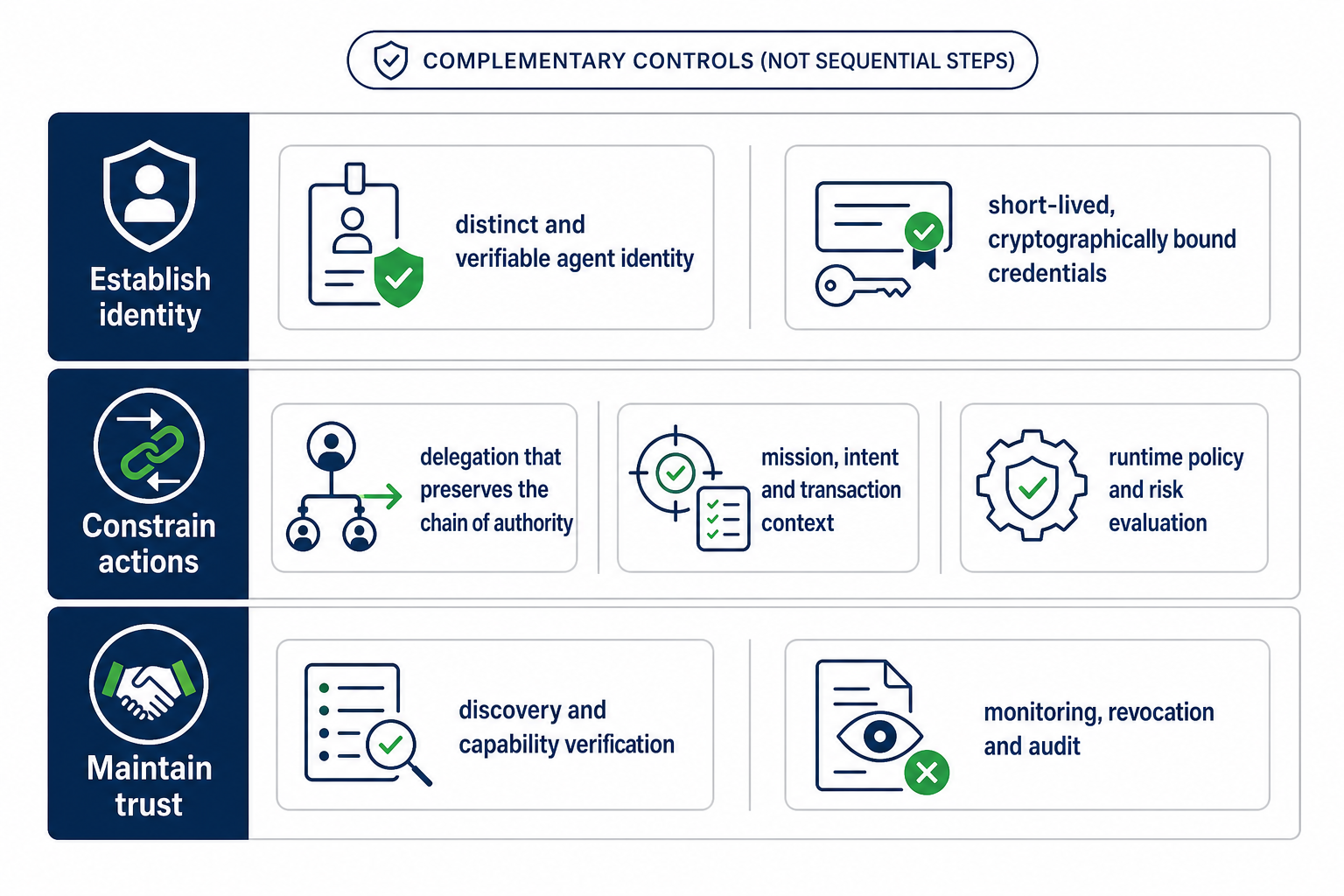
Establish identity: Give each agent a distinct identity, separate from its delegating user or hosting platform. Use short-lived, rotatable credentials that prove key control, with issuance checks appropriate to the software and runtime environment.
Constrain actions: Preserve the delegation chain and define task, data, amount, recipient and time limits. Verifiable intent connects authenticated approval to the permitted action. Recheck authority and risk at execution, applying the principle of context-aware authentication and requiring explicit approval for sensitive actions.
Maintain trust: Protect discovery records and verify capabilities before agents use other services. Monitor actions and retain evidence linking the agent, delegating principal, policy decision and outcome. When authority expires, is revoked or risk changes, invalidate credentials and terminate downstream access as needed.
Emerging approaches to agent identity and trust
| Approach | What it contributes | Important consideration |
|---|---|---|
| Workload identity | Machine-verifiable identity for agents and services | It must be connected to authorization and audit controls |
| OAuth profiles and token exchange | Delegated access and cross-service authorization | Scopes may need richer task and transaction constraints |
| SPIFFE and WIMSE | Short-lived workload credentials and proof of identity | Authentication does not decide what an agent may do |
| DIDs and verifiable credentials | Portable, signed claims about an agent, organization or capability | Trust registries, privacy and governance must be defined |
| Zero trust policy | Repeated evaluation based on identity, context and risk | Policies need accurate signals and clear ownership |
| Intent-aware payment models | A way to connect a delegated purchase to consumer authority | Interoperability between issuers, merchants and agents remains under development |
The practical direction is layered rather than singular. Organizations can combine established workload identity and authorization standards with new profiles for agent delegation, capability discovery, intent and runtime risk.
How agent identity affects banking and payments
Agentic systems can change the point at which a financial institution must establish trust. The institution may need to assess the human, the agent, the device, the application, the merchant, the transaction and the downstream service as one connected interaction.
Relevant use cases include:
- Account servicing: an agent answers questions or prepares a change while access to sensitive actions remains constrained.
- Payment initiation: an agent prepares or submits a transaction within amount, merchant, recipient and time limits.
- Fraud operations: an investigative agent retrieves evidence and recommends action while preserving analyst approval for material decisions.
- Merchant and issuer coordination: payment participants validate agent identity, consumer intent and transaction evidence.
- Account recovery: identity proofing and contextual risk assessment are combined before control is restored.
Financial institutions should connect agent controls to existing identity proofing, authentication, fraud decisioning and transaction-monitoring processes. This avoids creating an isolated trust layer that cannot explain the customer or transaction context. Entersekt explores the wider shift toward decisions that connect identity, intent, risk and evidence in Four shifts redefining trust in digital payments.
What should financial institutions do now?
Start with a clear inventory of agents, owners, tools, data stores and actions. Classify each agent by autonomy, sensitivity, transaction authority, duration and potential impact. This creates the basis for proportionate policy instead of treating every agent as equally risky.
- Assign every agent a distinct identity and owner.
- Use short-lived, rotatable credentials with proof of key control where possible.
- Separate agent identity from the human or institution that delegates authority.
- Define task, transaction, data and time boundaries.
- Require stronger approval for irreversible or high-value actions.
- Record the full delegation and tool-call chain.
- Test revocation, incident response and policy changes before production use.
- Measure false declines, customer friction, fraud outcomes and investigation effort.
For customer-facing banking journeys, the control should also fit the customer experience. Entersekt’s digital banking fraud prevention approach connects authentication with transaction context and risk, which is relevant when an agent’s action affects a customer’s account or money. Its guide to building digital banking journeys that resist social engineering attacks explains how contextual prompts and risk-based approval can protect sensitive actions without interrupting routine activity.
Common mistakes to avoid
- Giving an agent a shared service identity: this obscures accountability and makes fine-grained policy difficult.
- Passing a user’s broad access to an agent: delegated authority should be narrower than the principal’s full entitlement.
- Trusting the platform alone: a trusted host does not make every agent action trustworthy.
- Relying on static API keys: long-lived bearer secrets are difficult to attribute, rotate and constrain.
- Logging only the final result: the decision chain and authorization context are needed for investigation.
- Treating user intent as permanent: consent may expire, be revoked or become inconsistent with the requested action.
- Assuming authentication equals authorization: proving which agent is calling does not prove that the call should be allowed.
FAQs about agent identity and trust frameworks
➡️ Difference between an agent identity and a user identity?
An agent identity identifies the software actor making a request, while a user identity identifies the person or organization that may have delegated authority. A trustworthy audit trail records both identities when an agent acts for a user.
➡️ Do AI agents need their own credentials?
Yes. An agent should have credentials that identify it and prove control of its cryptographic identity. Those credentials should be short-lived, rotatable and separate from the credentials of the language model, user or platform hosting the agent.
➡️ Can OAuth support agent authorization?
OAuth can support delegated agent authorization, especially when combined with token exchange, constrained scopes, transaction context and explicit approval. Agent deployments still need clear identity binding, delegation records, policy enforcement and monitoring around the OAuth flow.
➡️ How do agent trust frameworks support payments?
They connect the agent, delegating user, payment authority, transaction details and merchant interaction. This can help participants evaluate whether a payment matches authorized intent and preserve evidence for risk decisions, disputes and compliance.
➡️ What is the role of authentication in agent trust?
Authentication establishes confidence in which agent is communicating. Trust decisions also require authorization, runtime posture, user or system delegation, transaction context, risk evaluation and audit evidence. Entersekt applies this broader context to financial authentication and fraud prevention.
Sources and related articles
- NIST concept paper on software and AI agent identity and authorization
- IETF draft on AI agent authentication and authorization
- Cloud Security Alliance guidance on agentic AI identity and access management
- EMVCo work on global specifications for agentic payments
- EMVCo framework for secure, interoperable and scalable card-based agentic payments
Standards and proposals for agent identity, authorization and agentic payments are developing rapidly. Treat draft specifications as work in progress and validate implementation and regulatory requirements for each jurisdiction and use case.