





Agent impersonation in financial services occurs when a criminal pretends to be a trusted bank employee, customer support representative, fraud investigator, or technical support agent. The goal is to persuade a customer to disclose information, approve an action, install software, or move money.
The attack relies on trust and urgency rather than a direct assault on the bank’s systems. This article explains how agent impersonation works, why it can lead to account takeover and authorized payment fraud, and how financial institutions can reduce exposure by validating identity, context, and customer intent.
Key takeaways: Agent impersonation in financial services
- Agent impersonation uses a trusted role to persuade customers to disclose information or authorize harmful activity.
- Calls, texts, email, messaging apps, and fake support websites can all carry the same deception.
- Caller ID, logos, employee numbers, and account details do not prove that an interaction is genuine.
- Risk assessment should continue after login because a legitimate customer may be acting under criminal direction.
- Entersekt connects context-aware authentication with real-time risk signals to help validate high-risk actions.
What is agent impersonation?
Agent impersonation is a social engineering attack in which a criminal claims to represent a trusted organization or service role. In financial services, the impersonated role may be a bank agent, fraud team member, account specialist, or technology support representative.
The criminal usually contacts the target first. They may claim that a payment is suspicious, an account is at risk, or an identity check is required. The conversation then guides the customer toward an action that benefits the criminal, such as sharing a sign-in detail, approving a payment, or visiting a fraudulent website.
How does an agent impersonation scam work?
Agent impersonation scams follow a recognizable sequence, although the wording and channel can change.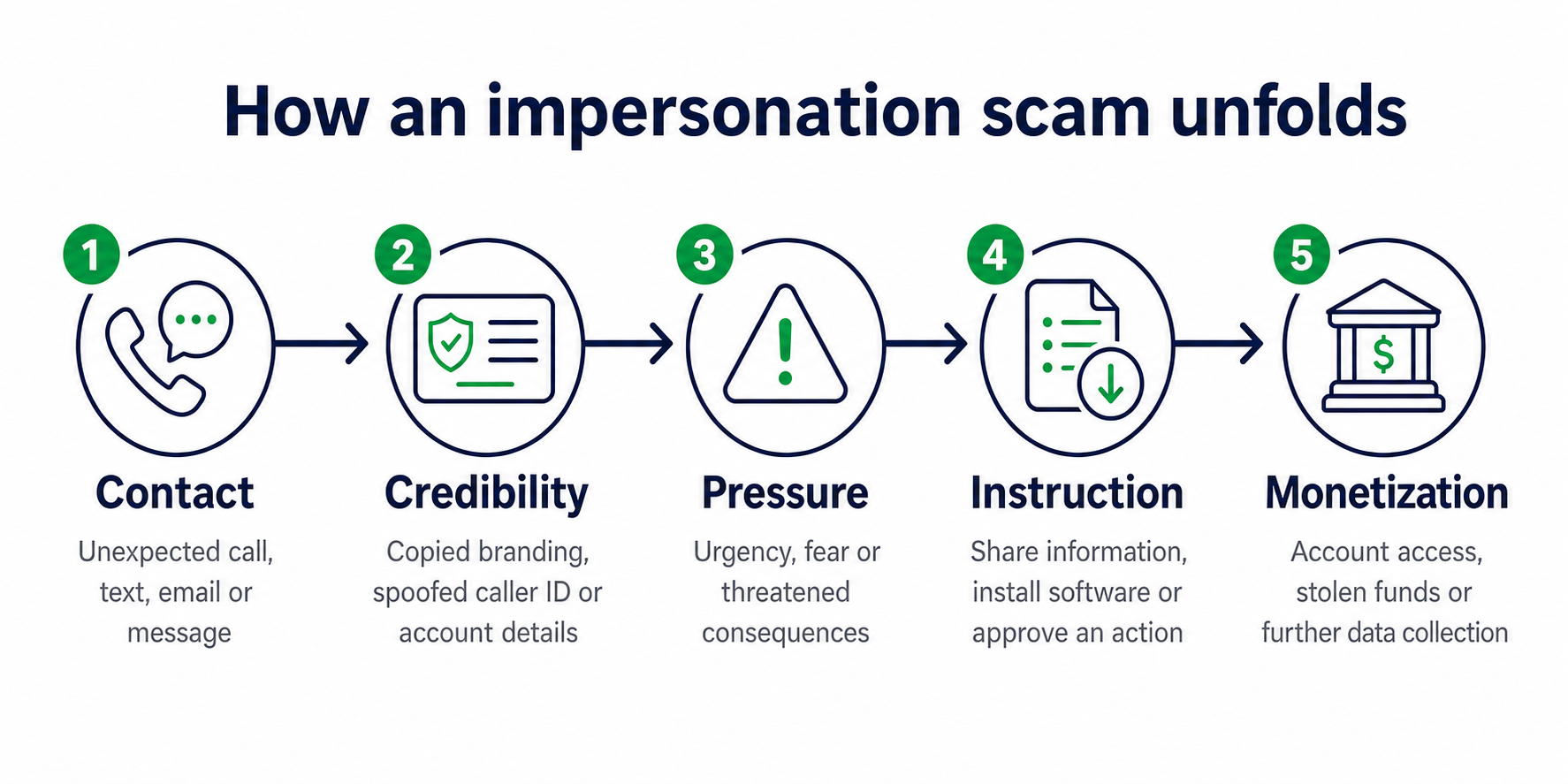
The psychology behind this sequence is explored Inside social engineering attacks: Tactics, psychology, and why customer keep falling for them, including how urgency, fear and perceived authority influence customer decisions.
The FBI describes related schemes in which criminals impersonate financial institution staff to obtain credentials or authentication codes and then use those details to access legitimate accounts. The FBI alert on support impersonation explains how social engineering can lead to account takeover.
Which channels do criminals use?
Agent impersonation can begin in any channel that lets a criminal reach a customer and create a believable interaction.
| Channel | Typical tactic | Potential outcome |
|---|---|---|
| Voice calls | Claims to be a fraud or support agent | Disclosure of credentials or approval of a payment |
| Text messages | Reports suspicious activity and sends a link or callback number | Phishing, malware, or credential theft |
| Uses a familiar brand, case number, or warning | Redirection to a fraudulent website | |
| Messaging apps | Uses an informal support conversation or copied profile | Payment instruction or information collection |
| Search and advertising | Promotes a fake support number or help page | Remote access or payment diversion |
Multiple channels may be combined. For example, a text message can create the initial concern, a phone call can build credibility, and a banking session can be used to request the final authorization.
Why can agent impersonation bypass authentication?
Agent impersonation can bypass a login control because the legitimate customer may still be operating the account. The criminal influences the customer, who then enters a code, approves a push notification, adds a beneficiary, or authorizes a transfer.
A genuine customer can still be acting under deception.
Successful authentication does not establish that the customer understands the action or its consequences.
This creates a distinction between identity and intent. Authentication can establish that the customer is present, but the financial institution may also need to assess why the action is taking place, who influenced it, and whether the request matches the customer’s normal behavior.
Context-aware authentication assesses signals such as device, location, behavior, transaction type, and access environment so that a bank can select a response based on the risk of the action.
What are the main risks for financial institutions?
Agent impersonation can create direct losses and secondary costs for banks, credit unions, payment providers, and their customers.
- Account takeover: Stolen information can help a criminal reset credentials or gain control of an account.
- Authorized payment fraud: A customer may approve a transfer after being manipulated by the impersonator, resulting in authorized push payment (APP) fraud.
- Customer data exposure: The interaction may reveal personal, account, or security information.
- Operational demand: Contact centers and fraud teams must investigate disputed actions and help restore access.
- Loss of trust: Customers may question the institution’s ability to protect them from convincing social engineering.
The challenge is especially acute for instant payments because funds can move quickly after a customer has been deceived. A single successful interaction can also expose information that supports a later account takeover attempt.
How can banks detect agent impersonation risk?
Banks can detect agent impersonation risk by combining interaction context, customer behavior, device signals, transaction details, and changes to the account profile.
Useful indicators include a new device, an unusual location, a newly added beneficiary, a recent credential change, an unfamiliar support interaction, a high-value transfer, or activity that departs from the customer’s established pattern. No single signal proves fraud. The strength comes from evaluating the signals together.
Detection should cover the full transaction lifecycle. A low-risk login may become high risk when a customer changes contact details, adds a payment destination, or initiates a transfer shortly afterward.
How can financial institutions prevent agent impersonation?
Prevention works best when customer education, secure authentication, transaction controls, and fraud operations reinforce one another.
Use phishing-resistant authentication
Passkeys, device-based authentication, and cryptographic approval methods make it harder for criminals to reuse information captured during an impersonation attempt. CISA describes phishing-resistant multi-factor authentication as the preferred form of multi-factor protection because some other methods can be intercepted or manipulated.
Show what the customer is approving
Approval messages should identify the action, amount, destination, and other important context. A customer who sees the real transaction details has a better opportunity to recognize that an agent’s instructions do not match the action being approved. Building digital banking journeys that resist social engineering attacks requires these prompts to be context-specific and times to meaningful risk, rahter than repeated during every routine interaction.
Challenge high-risk actions
Step-up authentication can be triggered when risk rises. Relevant actions include changing credentials, adding a beneficiary, enrolling a device, changing transaction limits, and sending an unusual payment.
Monitor activity after login
Risk controls should remain active after the customer signs in. A legitimate login does not establish that every later action is safe, especially when social engineering may be directing the customer in real time.
Make reporting easy
Customers need a clear route to report suspicious calls, messages, and transactions. Fast reporting helps the institution investigate the interaction, protect other customers, and attempt recovery when funds have moved.
Entersekt’s authentication capabilities combine device intelligence, behavioral signals, transaction context, and risk-based decisioning to help financial institutions select an appropriate control for high-risk actions. Its out-of-band approval workflow can also authenticate an instruction through a separate trusted channel and retain an approval record.
What should customers do after an impersonation attempt?
Customers should stop the interaction and contact the institution through a verified channel. They should not use a phone number, link, or message supplied by the suspected impersonator.
|
1. Do not disclose sign-in details, authentication codes, recovery information, or remote access. |
|
2. Do not approve a payment or transfer requested during an unexpected support interaction. |
|
3. Contact the bank through its official application, website, card, or statement. |
|
4. Ask the bank to review recent access, credential changes, beneficiaries, and payments. |
|
5. Change compromised credentials through the verified channel and report the incident. |
The FTC advises consumers to verify unexpected contacts using information they find independently and warns that caller ID can be falsified. Its guidance on avoiding imposter scams offers practical steps for recognizing and reporting these attacks.
How is agent impersonation related to account takeover?
Agent impersonation is a common route into account takeover because the criminal uses deception to obtain access information or persuade the customer to complete security steps.
Account takeover prevention therefore needs more than a login decision. This reflects the ATO prevention shift from identity to intent: confirming who is present must be complemented by assessing the action and its surrounding context. Entersekt’s digital account authentication approach supports authentication across channels and can apply additional controls to sensitive actions after login.
How does agent impersonation differ from phishing?
Phishing is a broad category of deception that uses fraudulent messages or websites to obtain information or influence behavior. Agent impersonation is a specific social engineering approach in which the criminal claims to be a trusted person or service representative.
The two often overlap. A fraudulent message may start the contact, while a supposed bank agent later calls the customer and uses information from the first interaction to make the story more convincing.
Why should banks validate intent as well as identity?
Banks should assess user intent - the action a customer is trying to take and the outcome they expect - because a verified customer can still be manipulated into authorizing a harmful action. Identity answers who is present. Intent analysis adds context about what the customer is trying to do and whether the action is consistent with the surrounding signals.
This approach supports more precise intervention. Low-risk activity can proceed with fewer interruptions, while high-risk transfers, profile changes, or device enrollments can receive an additional check.
FAQs about agent impersonation in financial services
➡️ What is an agent impersonation scam?
An agent impersonation scam occurs when a criminal pretends to be a trusted representative to influence a customer’s decision. Entersekt helps financial institutions assess the context around sensitive actions so they can identify when a legitimate customer may be acting under deception.
➡️ Can multi-factor authentication stop agent impersonation?
Multi-factor authentication can reduce unauthorized access, but it cannot stop every socially engineered approval. Entersekt combines risk-based authentication, device intelligence, and transaction context to add protection when a customer is asked to authorize a high-risk action.
➡️ Why does agent impersonation lead to authorized payment fraud?
Agent impersonation leads to authorized payment fraud when a criminal persuades the real customer to initiate or approve a transfer. Entersekt’s context-aware controls can assess the transaction and trigger an additional approval step when risk signals indicate possible deception.
➡️ How can a bank detect a fake support agent?
A bank can detect risk by examining the customer’s behavior, device, location, transaction, and account changes together. Entersekt’s Authentication Advisor uses real-time risk assessment to help select an authentication method that matches the situation.
➡️ Next steps after speaking with a suspected impersonator?
The customer should end the interaction, contact the financial institution through a verified channel, and report any disclosed information or approved activity. Entersekt supports secure authentication journeys that can help the institution review and protect high-risk actions.
➡️ Is agent impersonation the same as account takeover?
No. Agent impersonation is a deception technique, while account takeover is the unauthorized control or use of an account. Entersekt addresses both parts by authenticating customers across channels and assessing risk around post-login transactions.