





Credential misuse is the unauthorized use, theft, disclosure, sharing, alteration, or exploitation of credentials that control access to an account, service, device, or payment. In financial services, it can expose digital banking accounts, payment instruments, transaction approval flows, and recovery processes to fraud.
Credentials include sign-in secrets, authentication tokens, recovery codes, cryptographic keys, payment card details, and other evidence used to establish identity or authorize an action. Credential misuse becomes especially dangerous when a valid credential is used in a way that does not match the account holder’s intent.
This entry explains how credential misuse happens, how it differs from related fraud types, and which controls help financial institutions reduce exposure across account access and payment journeys.
Key takeaways: credential misuse
- Credential misuse includes theft, sharing, replay, alteration, and unauthorized use of payment or authentication credentials.
- Credential stuffing tests stolen sign-in combinations against many services, exploiting credential reuse across accounts.
- Account takeover often begins with compromised credentials, but fraud can continue after a legitimate customer signs in.
- Payment credentials can be misused for unauthorized purchases, account changes, transfers, and card-not-present fraud.
- Entersekt connects risk signals and authentication decisions across digital banking and payment interactions.
What is credential misuse in financial services?
Credential misuse occurs when someone uses a credential outside its authorized purpose, control, or context. The misuse may involve a criminal, a compromised device, a malicious insider, a dishonest third party, or a customer who has been manipulated into revealing or approving something.
The term covers more than stolen sign-in details. A fraudster may misuse a session token, recovery code, device credential, payment card number, digital wallet token, API key, or transaction approval. The impact depends on what the credential unlocks and whether additional controls verify the action. Replay protection helps prevent misuse by ensuring that a captured authentication response or transaction approval cannot be reused outside its permitted time window, session, or transaction. Where single-use enforcement is required, it also prevents the same response or approval from being accepted more than once.
Which credentials are commonly misused?
| Credential type | What it controls | Examples of misuse |
|---|---|---|
| Account credentials | Access to online banking, merchant, or payment accounts | Credential stuffing, phishing, account takeover, and unauthorized profile changes |
| Authentication credentials | Proof that a customer controls an account or device | Replay, interception, social engineering, and unauthorized approval |
| Payment credentials | Card, wallet, or account-to-account payment initiation | Unauthorized purchases, card testing, fraudulent transfers, and token misuse |
| Recovery credentials | Account recovery or credential replacement | Fraudulent resets, takeover persistence, and contact-detail changes |
| Service credentials | Access for software, APIs, or automated processes | Data access, privilege escalation, lateral movement, and unauthorized transactions |
NIST describes authentication as verifying that a claimant controls one or more authenticators associated with a subscriber account. That distinction matters: control of a credential can establish participation, but it does not always establish that the customer understood or intended the action.
How does credential misuse happen?
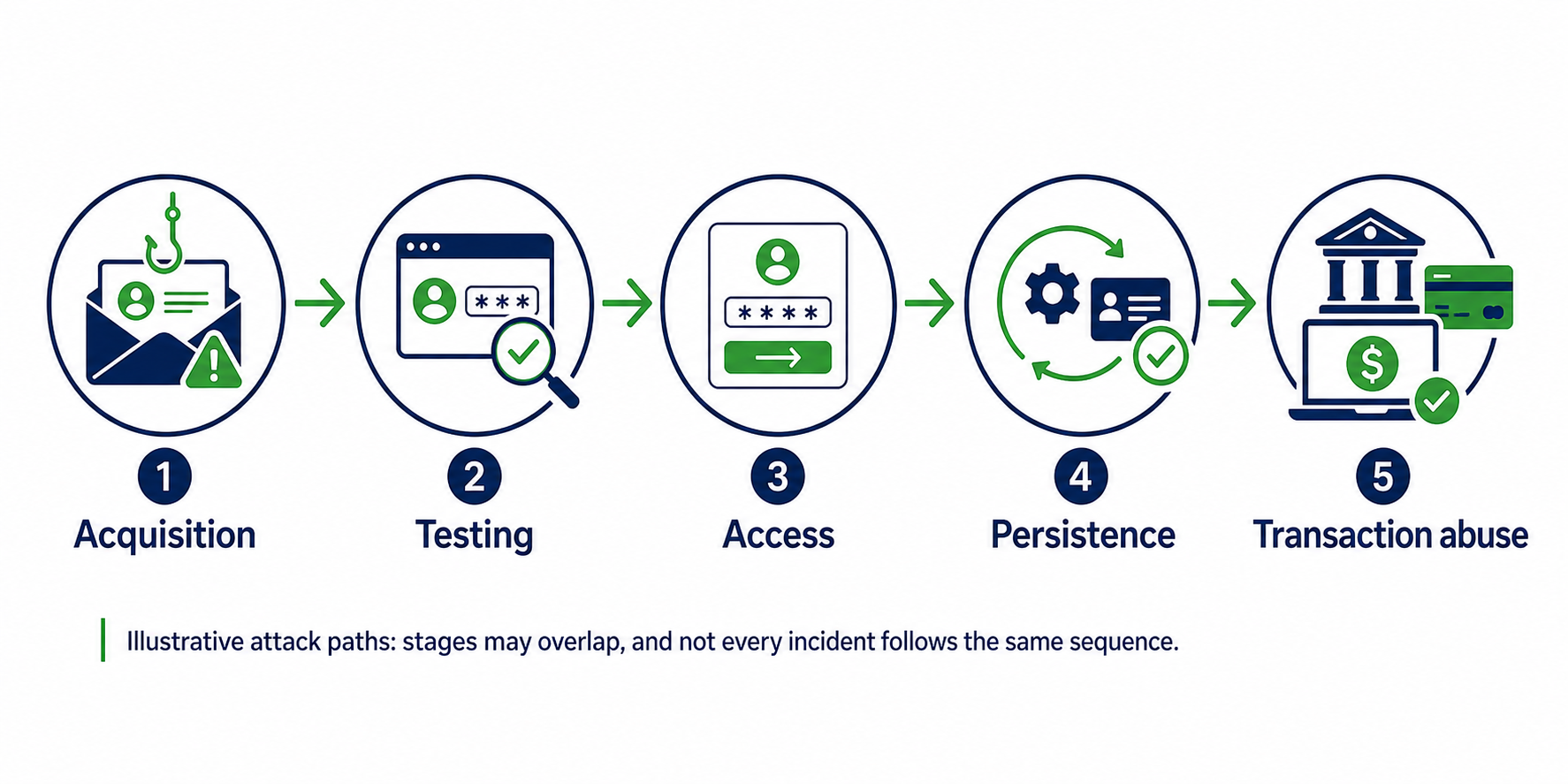
Credential misuse usually begins with acquisition, followed by testing, access, persistence, or transaction abuse. Attackers may obtain credentials through phishing, malware, data breaches, credential stuffing, social engineering, or exposed secrets in code and configuration files.
Credential theft and phishing
Phishing persuades a customer to enter or disclose a credential through a fraudulent page, application, message thread, or phone call. Social engineering can also persuade a customer to approve a legitimate authentication request while the criminal controls the underlying session.
Credential stuffing
Credential stuffing uses automated attempts to test stolen combinations of usernames and sign-in secrets against other services. It works when customers reuse credentials across accounts. CISA classifies credential stuffing as a brute-force sub-technique and recommends phishing-resistant multi-factor authentication, monitoring, and rapid credential resets after compromise.
Financial institutions should also treat unusual login velocity, device changes, failed-attempt patterns, and access from unexpected locations as signals for risk assessment. No single signal proves misuse, but several signals can justify step-up authentication or a transaction hold.
Post-login misuse
Credential misuse can continue after a valid login. A criminal may add a beneficiary, change contact details, reset a credential, raise a payment limit, or initiate a transfer from an authenticated session. A legitimate customer may also perform the action after being deceived by an impersonator. The distinction underpins the ATO prevention shift from identity to intent: a valid authentication event must be considered alongside the action, customer behavior, and transaction context.
What is the relationship between credential misuse and account takeover?
Credential misuse is a broader activity, while account takeover is a specific outcome in which an unauthorized person gains control of a legitimate account. Compromised credentials are one route to account takeover, alongside session theft, recovery abuse, device compromise, and social engineering.
The distinction helps financial institutions design better controls. Account access controls address unauthorized entry, while post-login monitoring and transaction authentication address harmful activity after entry. Entersekt’s digital banking approach connects authentication and fraud signals across login, account changes, and high-risk transactions. Read more about account takeover fraud.
How are payment credentials misused?
Payment credential misuse occurs when payment details or payment authorization are used without valid authority, or when a customer is manipulated into approving a payment they did not intend to make.
- Card-not-present fraud: Stolen card details are used for online purchases where the physical card is absent.
- Digital wallet misuse: A compromised wallet or device is used to initiate payments.
- Unauthorized transfers: Stolen access enables wire, automated clearing house, or real-time payment activity.
- Authorized push payment scams: A customer approves a payment after deception, impersonation, or pressure.
- Account changes: A criminal changes a payee, contact details, a transaction limit, or a recovery method before moving funds.
Payment authentication must therefore bind approval to meaningful transaction details, such as the amount, recipient, channel, and device context. Verifying the customer alone is insufficient when the customer has been manipulated or the transaction details have changed.
Glenbrook Partners' white paper, Tokenization and 3-D Secure: Complementary Components of Modern Risk Management, explains why protecting a payment credential must be complemented by authentication and contextual risk assessment.
How can financial institutions reduce credential misuse?
Financial institutions reduce credential misuse through layered controls that protect credential issuance, use, recovery, and payment authorization. The strongest programs combine prevention, detection, adaptive authentication, and rapid response.
Entersekt's article 3 Ways to win against account takeover fraud explores how multi-factor authentication, passwordless methods, and real-time risk assessment can strengthen protection against compromised credentials.
- Use phishing-resistant authentication: FIDO2 and passkeys use public-key cryptography and bind credentials to the service domain, reducing exposure to credential disclosure and replay.
- Assess risk at high-value moments: Evaluate device, behavior, location, transaction details, and account changes before deciding whether to allow, challenge, delay, or decline an action.
- Continue monitoring after login: Review activity after authentication because a valid session can still be compromised or manipulated.
- Protect recovery journeys: Apply strong verification to credential resets, new-device enrollment, contact-detail changes, and beneficiary creation.
- Respond quickly to exposure: Revoke or replace compromised credentials, review related activity, notify affected customers, and investigate connected accounts and devices.
Entersekt’s Authentication Advisor dynamically adjusts authentication methods using real-time risk assessment across digital banking and e-commerce use cases. This model supports targeted challenges at high-risk moments instead of applying the same control to every interaction.
How do passkeys reduce credential misuse?
Passkeys reduce credential misuse by replacing shared sign-in secrets with cryptographic key pairs. The private key stays with the customer’s device or security key, while the service stores a related public key.
Public-key verification lets the service check a signature created with the corresponding private key without requiring the customer to disclose that key.
FIDO states that passkeys are unique to an online service and designed to resist phishing. The customer unlocks the device with a local biometric or PIN, while the credential is not typed into a fraudulent site. Passkeys do not eliminate every account or device risk, so institutions still need recovery controls, device-risk assessment, and transaction monitoring.
Credential misuse, authentication, and authorization
Authentication answers who is controlling an account or credential. Authorization answers what that person or system is allowed to do. Credential misuse can undermine either process when a stolen credential is accepted as proof of identity or a valid customer is manipulated into approving an unauthorized outcome.
|
A valid credential does not guarantee a legitimate action. Risk assessment should continue through account changes, recovery, and payments, not stop at login. |
Where one party authenticates a customer for another, delegated authentication also requires the receiving service to validate the evidence, its scope, and its relevance to the requested action.
Authentication and authorization should stay connected to the action being requested. A customer who signs in successfully may still need additional verification before adding a payee, changing a recovery method, or approving an unusual transfer. Entersekt’s user intent guidance explains why identity alone does not establish the customer’s intended outcome.
Authoritative guidance on credential misuse
Several primary sources help security and fraud teams build a sound control framework:
- CISA guidance on credential stuffing explains how attackers test reused credentials and classifies the technique under brute force.
- NIST SP 800-63B defines authentication and sets requirements for authenticators and assurance levels.
- FIDO guidance on passkeys explains the public-key process behind phishing-resistant authentication.
These sources are technical references, not a substitute for a financial institution’s risk assessment, regulatory analysis, incident response plan, or customer protection obligations.
FAQs about credential misuse
➡️ What is an example of credential misuse?
An example is a criminal using a stolen sign-in credential to access a bank account, change a recovery detail, and initiate a transfer. The credential may have been acquired through phishing, a breach, or credential stuffing. Entersekt connects risk assessment with authentication to help detect high-risk actions after login.
➡️ Is credential misuse the same as credential theft?
Credential theft is the unauthorized acquisition of a credential, while credential misuse is the unauthorized use or exploitation that follows. A stolen credential can be sold, tested, replayed, or used to take over an account. Entersekt’s cross-channel authentication approach helps institutions address both access risk and transaction risk.
➡️ Can multi-factor authentication prevent credential misuse?
Multi-factor authentication can reduce credential misuse, but its effectiveness depends on the authenticator and the attack context. Phishing-resistant methods offer stronger protection than codes that customers can be persuaded to disclose. Entersekt supports passwordless and context-aware authentication for higher-risk digital banking actions.
➡️ How does credential misuse affect payment fraud?
Credential misuse can expose card payments, digital wallets, account transfers, and payment-account changes. It can also enable a scam in which a customer approves a transaction after manipulation. Entersekt helps financial institutions assess payment context and apply authentication at the point of risk.
➡️ What should a financial institution do after credential exposure?
A financial institution should contain the exposure, revoke or replace affected credentials, review authentication and payment activity, contact impacted customers, and investigate related accounts and devices. Entersekt’s risk-aware authentication model can add protection to login, recovery, and high-risk transaction flows while the incident is investigated.