





Commerce Signals are structured details about a purchase, payment instruction, or delegated buying action that help financial-services participants understand what happened and decide how to manage it. The term is increasingly associated with agentic commerce, where an artificial intelligence agent can discover products and make purchases on a person’s behalf.
In this context, Commerce Signals can connect the user’s original instruction with the authorized purchase, payment credentials, merchant, amount, and transaction outcome. That record can support payment controls, authentication decisions, monitoring, and dispute handling.
What are Commerce Signals?
Commerce Signals are transaction and authorization data points that describe the context behind a purchase. They can show what a customer instructed an agent to do, which payment credentials were used, where the purchase was made, and whether the final authorization matched the original instruction.
The exact data set depends on the payment ecosystem. Potential signals include the customer’s authenticated intent, merchant details, purchase amount, currency, token reference, agent identity, authorization result, and fulfillment outcome. A signal is useful because it adds context to the payment event rather than treating the transaction as an isolated approval request.
Why Commerce Signals matter in agentic commerce
Commerce Signals help establish accountability when software acts on a customer’s behalf. An AI agent may search, compare, select, and purchase products faster than a person can complete each step manually. That efficiency creates a new requirement: payment systems must distinguish delegated, authorized activity from unauthorized automation.
Visa’s Intelligent Commerce documentation describes signals as a way to connect a user’s original instruction and the details of authorized purchases. The resulting record can assist with dispute resolution when a transaction is later questioned. Visa also describes controls that compare payment requests with authenticated instructions.
This makes Commerce Signals relevant to several parties:
- Customers: Their instructions and purchase boundaries can be recorded more clearly.
- Agents: Their payment activity can be tied to a specific delegated task.
- Merchants: They can receive stronger evidence about the authorization context.
- Issuers and payment networks: They can assess the relationship between intent, credentials, merchant, and outcome.
- Fraud and dispute teams: They can investigate transactions using more than an approval code alone.
How Commerce Signals work
Commerce Signals generally form an evidence chain across the buying journey. The chain begins with a customer instruction and continues through authentication, token use, payment authorization, and the final purchase outcome.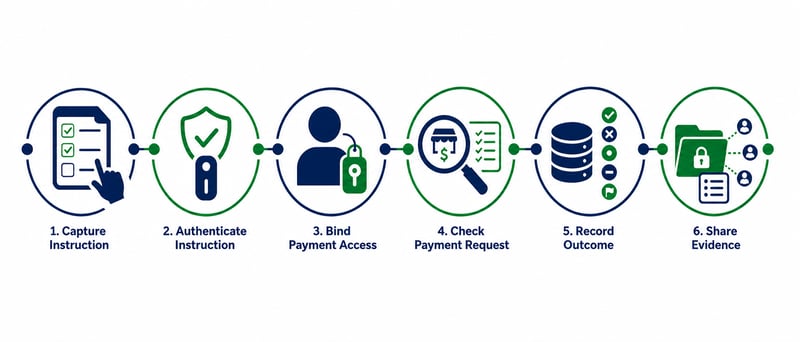
- Capture the instruction. The customer defines what an agent may purchase, such as a product category, merchant, price limit, or time period.
- Authenticate the instruction. The customer confirms the instruction using an accepted authentication method, such as a passkey or another high-assurance factor.
- Bind payment access to the agent. An agent-specific token or credential can help limit how the payment instrument is used.
- Check the payment request. Payment controls compare the requested merchant, amount, and other details with the authenticated instruction.
- Record the outcome. The ecosystem records whether the purchase was approved, declined, completed, canceled, or disputed.
- Share relevant evidence. Authorized parties can use the resulting data to investigate exceptions and resolve disputes.
This process separates product discovery from payment authorization. An agent finding an item does not automatically mean that it has permission to buy it. The customer’s instruction, the payment request, and the final transaction must remain connected.
Commerce Signals and payment authentication
Payment authentication answers whether a person or authorized party has approved an action. Commerce Signals add context about what was approved and how the final purchase relates to that approval.
For example, a customer may authorize an agent to purchase a flight below a stated amount from a defined list of airlines. Authentication confirms the customer’s approval. Commerce Signals can then help show whether the agent requested the correct payment credentials, used them with the intended merchant, and stayed inside the agreed limits.
This distinction matters for financial institutions. Authentication alone may confirm the source of an instruction, while contextual payment data helps assess the integrity of the resulting transaction. Entersekt’s Context Aware Authentication follows a related principle in banking and payments by assessing behavior, device, transaction, channel, and user context when deciding how to authenticate an interaction.
Commerce Signals and fraud prevention
Commerce Signals can support fraud prevention by adding transaction context to risk analysis. They can help identify inconsistencies between a customer’s instruction and the payment event, such as a different merchant, unexpected amount, or payment request outside the approved scope.
Signals do not replace authentication, authorization, or fraud decisioning. They are inputs to those controls. Their value depends on data quality, clear consent, reliable identity binding, and rules that define what an agent may do.
In digital banking, the same principle applies beyond agentic commerce. Risk teams can assess account access, device context, transaction behavior, and activity across channels before deciding whether to allow, challenge, or decline an action. Entersekt’s Authentication Advisor is designed to turn real-time behavioral, device, and ecosystem signals into authentication guidance for banking and payment interactions.
Commerce Signals and dispute resolution
Commerce Signals can make disputes easier to investigate by preserving evidence about the customer’s original intent and the purchase that followed. This can help answer questions such as who authorized the action, which agent acted, what limits applied, which merchant received the payment, and whether the final amount matched the instruction.
That evidence does not guarantee that a dispute will be resolved in favor of any party. It gives issuers, networks, merchants, and customers a clearer record for reviewing the event. The strength of the record depends on the accuracy, integrity, and accessibility of the underlying data.
How Commerce Signals relate to EMV 3-D Secure
Commerce Signals and EMV 3-D Secure serve related but different roles. EMV 3DS is a payment authentication framework for card-not-present transactions. It enables data exchange between merchants and issuers so the issuer can assess the transaction and authenticate the cardholder when needed.
Commerce Signals can add information about intent, delegation, agent activity, and purchase outcomes, especially in agentic commerce. EMV 3DS can support the authentication and risk assessment of the card payment itself. Together, these concepts point toward payment decisions that account for both identity and transaction context.
EMVCo explains that EMV 3DS messages can include transaction, payment-method, and device information. Its official EMV 3-D Secure overview describes how the framework supports card-not-present fraud prevention and e-commerce authentication.
What financial institutions should consider
Financial institutions assessing Commerce Signals should begin with governance rather than technology. The central question is what a customer is authorizing, how that authorization is recorded, and how the institution can verify that a later payment stays inside the approved boundaries.
- Consent: Define how customers grant, limit, review, and revoke an agent’s authority.
- Identity: Bind the customer, agent, token, merchant, and payment instruction clearly.
- Authentication: Use an authentication method that matches the risk of the instruction and transaction.
- Controls: Check merchant, amount, currency, timing, category, and other policy conditions.
- Auditability: Retain evidence that shows what was approved and what occurred.
- Privacy: Share only the data needed for authorization, risk management, fulfillment, and dispute handling.
- Interoperability: Align the data model with payment networks, merchants, processors, and existing fraud systems.
A financial institution should also plan for exceptions. An agent may encounter an unavailable product, a changed price, a substituted merchant, or a transaction that requires additional approval. Clear policies should define when the agent must ask the customer again and when the payment must stop.
Commerce Signals in the wider payment ecosystem
Commerce Signals sit at the intersection of identity, payment authorization, tokenization, fraud prevention, and customer consent. They are part of a wider shift toward payments that evaluate the circumstances of an action rather than relying on a single credential or approval event.
For banks and payment providers, this creates an opportunity to connect data across the customer journey. Entersekt’s authentication platform brings risk intelligence, authentication, and payment security together so decisions can account for behavior, device, transaction, and cross-channel context.
The practical objective is clear: let authorized activity proceed, identify activity that falls outside the customer’s intent, and preserve enough evidence to explain the decision later.
Frequently asked questions about Commerce Signals
➡️ What is the simplest definition of Commerce Signals?
Commerce Signals are data points that describe the intent, authorization, and outcome behind a purchase. They connect a customer’s instruction to the payment event, helping authorized parties assess whether the transaction matched the approved context.
➡️ Are Commerce Signals only used for AI agents?
No. Commerce Signals are especially relevant to agentic commerce, but the broader idea applies to any payment process that needs richer context about intent, identity, device, merchant, transaction, and outcome.
➡️ Do Commerce Signals replace payment authentication?
No. Commerce Signals add context to payment authentication and risk decisioning. Authentication verifies approval, while signals can help explain what was approved, how it was used, and whether the final transaction matched the instruction.
➡️ How can Commerce Signals support fraud prevention?
Commerce Signals can reveal inconsistencies between an authorized instruction and a payment event. Entersekt combines context-aware authentication with risk intelligence to help financial institutions assess behavior, device, transaction, and channel context before applying the right control.
➡️ Why are Commerce Signals relevant to dispute handling?
Commerce Signals can preserve evidence about the customer’s original instruction, the agent that acted, the payment credentials used, and the completed purchase. This record can give dispute teams more context when reviewing a contested transaction.
➡️ What is the relationship between Commerce Signals and EMV 3DS?
EMV 3DS supports authentication and risk assessment for card-not-present payments. Commerce Signals can add delegated-intent and purchase-outcome context, helping connect an agent’s authorized instruction with the resulting payment.