






Transaction controls are rules that determine which payments or account actions may proceed, under what conditions, and when a customer or institution should be alerted or asked for additional verification. They can limit transaction amounts, restrict merchant categories, block channels or locations, control transaction frequency, and apply rules to specific payment types such as transfers, cash withdrawals, e-commerce purchases or recurring payments.
For financial institutions, transaction controls are a practical way to put boundaries around payment activity. Used well, they give customers more control over their money and help reduce exposure to unauthorized transactions, account takeover, payment fraud and some scam patterns. Used poorly, rigid controls can create false declines, customer frustration and avoidable support demand.
What are transaction controls?
A transaction control is a configurable condition applied to a payment or financial action. The condition may allow, decline, block, alert or route the transaction for additional review or authentication.
Examples include:
- Declining a card purchase above a defined amount.
- Allowing transactions only within a selected country or region.
- Blocking e-commerce, contactless, ATM or international transactions.
- Limiting the number or total value of transactions during a period.
- Allowing purchases at selected merchant categories while restricting others.
- Requiring additional verification for a high-risk transfer or a new beneficiary.
Controls may be set by a financial institution, a business managing commercial cards, or an individual customer through a banking or card-management channel. They may apply at card, account, customer, device, beneficiary, merchant, channel or portfolio level.
Transaction controls, fraud detection and authentication are different
These concepts work together, but they solve different problems:
| Concept | Primary question | Typical outcome |
|---|---|---|
| Transaction control | Does this action fit a defined policy or limit? | Allow, block, alert or apply a rule-based restriction |
| Fraud detection | Does this activity look anomalous or associated with fraud? | Risk score, review, decline or escalation |
| Authentication | Can the user or device prove the required identity or possession factor? | Approve authentication, fail it or apply step-up verification |
| Authorization | Should the transaction be approved by the issuer or account provider? | Approve, decline or refer for a decision |
A transaction can satisfy a spending limit and still be fraudulent. It can also be legitimate but exceed a customer-defined limit. Strong payment protection therefore combines policy controls with fraud decisioning and proportionate authentication.
How transaction controls work
A typical control flow has five stages: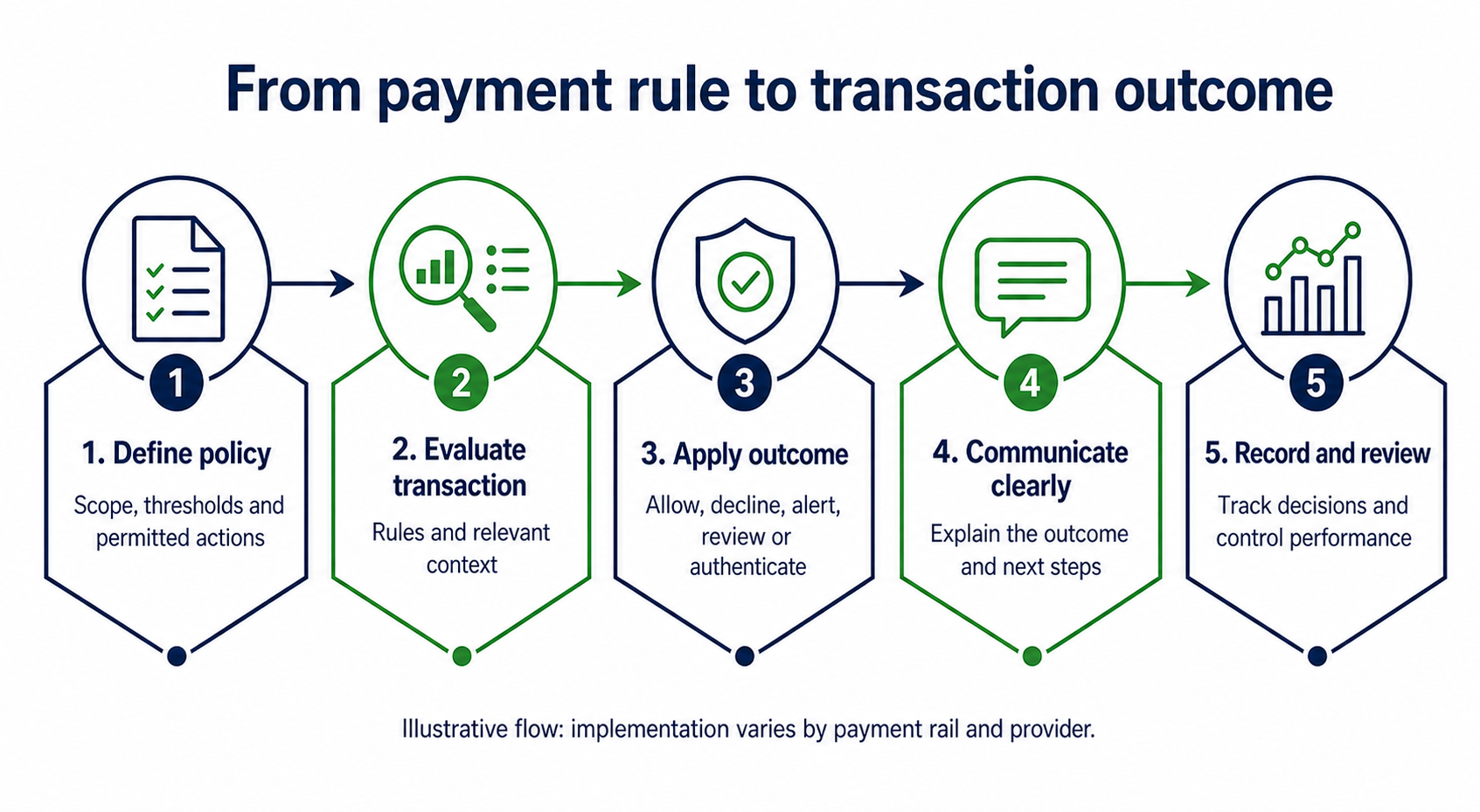
Controls may be evaluated before authorization, during a payment decision or as part of post-transaction monitoring. Exact architecture depends on the payment rail, issuer, processor, card network and regulatory environment.
Why transaction controls matter for fraud prevention
Transaction controls reduce the amount, reach or speed of activity that an attacker can achieve when credentials, a device or an account are compromised. They can also give customers an immediate way to pause a card or restrict a payment type instead of waiting for a fraud investigation.
Controls are not a substitute for risk-aware fraud prevention. A fraudster may stay below a limit, use a permitted merchant category or exploit a legitimate session after login. Financial institutions should combine controls with behavioral, device, transaction and cross-channel signals. The strongest decision is often not a blanket block, but the least intrusive action that addresses the risk: an alert, confirmation, step-up authentication, temporary hold or decline.
Entersekt’s context-aware authentication explains this broader approach: security controls should reflect the risk, channel and user context rather than treating every transaction the same.
Common types of transaction controls
| Amount and spending | Frequency and velocity | Merchant restrictions |
| Channel and transaction type | Location and time | Beneficiary and payee |
Amount and spending limits
Separate thresholds can apply to purchases, cash withdrawals and transfers. A lower threshold might trigger an alert or additional approval, while a higher threshold results in a decline. This allows institutions to distinguish activity that needs confirmation from activity outside permitted limits.
Frequency and velocity controls
Several transfers or beneficiary changes within a short period may warrant intervention even when each action falls below its individual limit. Velocity controls help restrict the pace of activity and reduce exposure during an attack.
Merchant and merchant-category restrictions
Commercial cards can restrict spending to approved suppliers or merchant categories. However, a merchant category code (MCC) may not describe every product a business sells, so these restrictions should be treated as policy filters rather than proof that a purchase is safe.
Channel and transaction-type controls
Controls can apply to how a transaction is initiated, including:
- In-store or card-present payments.
- E-commerce or card-not-present payments.
- Contactless payments.
- ATM withdrawals.
- Domestic or international payments.
- Recurring payments and subscriptions.
- Peer-to-peer payments and account transfers.
- Digital-wallet, tokenized or virtual-card transactions.
Channel controls are especially useful when a customer wants to disable a payment method temporarily, or when an institution needs different rules for different payment rails.
Location and time controls
Geographic controls can restrict transactions by country, region, merchant location or other location signals. Time controls can limit activity to business hours or a selected schedule. These rules are common in commercial payment programs, where a card may be intended for a particular territory, team or operating window.
Location should be treated carefully. A customer may legitimately travel, use a digital wallet or shop with a merchant whose processing location differs from its physical location. A rigid location rule can create unnecessary declines unless customers can update it easily or the institution can apply contextual exceptions.
These situations also help explain false declines in 3-D Secure and why good transactions get rejected: unfamiliar devices or locations can make legitimate activity appear risky when the surrounding context is missing.
Beneficiary and payee controls
For account-to-account payments, controls may govern who can receive money, when a new beneficiary can be used, how much can be sent, or whether a transfer requires confirmation. These rules are relevant to account takeover and authorized push payment (APP) fraud, where a customer may be manipulated into approving a payment to a fraudster.
Customer-configured versus institution-configured controls
| Customer-configured controls | Institution-configured controls |
|---|---|
| Give customers direct control over spending, channels and alerts. | Protect the institution, payment rail and customer base against known risk patterns. |
| Usually exposed through a banking app or online account. | Usually managed in authorization, fraud, card-management or payment systems. |
| May be temporary, such as disabling international transactions while a cardholder is at home. | May apply across a portfolio, product, merchant segment or risk tier. |
| Must be understandable and easy to change. | Must be governed, tested, auditable and aligned with applicable rules. |
The two layers should not conflict silently. If a customer changes a limit, the effect, start time, expiry and exceptions should be visible. If an institution overrides a customer setting for safety or compliance, the customer experience should explain the reason without exposing sensitive fraud controls.
Transaction controls and authentication
A control can trigger customer authentication when the transaction needs stronger evidence of customer intent. This is different from authenticating every transaction in the same way. A low-risk purchase may proceed without interruption, while a high-value transfer, new payee or unusual device may require a trusted-device approval, biometric verification or another strong factor.
In card-not-present payments, 3-D Secure provides a framework for exchanging transaction information and applying issuer authentication decisions. The objective is not maximum friction. It is an accurate decision that protects the payment while allowing legitimate customers through.
This broader role for payment authentication reflects the four shifts redefining trust in digital payments, including the need to connect identity, intent, risk and evidence.
Transaction controls should also be connected to intent. A customer who approves a login has not necessarily approved a beneficiary change or a payment. Each sensitive action should be described clearly enough for the customer to understand what they are authorizing.
Regulatory and payment-network considerations
Rules vary by jurisdiction, payment product and network. In the European Economic Area, the PSD2 regulatory technical standards address strong customer authentication and transaction-risk analysis. The European Banking Authority’s guidance discusses when transaction-risk analysis may support an exemption from SCA and emphasizes that institutions must apply the relevant requirements in force for their activity.
Payment networks also define their own operating rules and product capabilities. For example, Visa Transaction Controls supports configurable blocks and alerts for areas such as spend limits, cross-border transactions, ATM withdrawals, e-commerce, recurring payments, funds transfers and merchant-category controls. Availability and implementation details vary by market, card product and program.
Controls should therefore be designed with legal, compliance, scheme and operational teams. A rule that is technically possible may still be inappropriate for a specific product, region or customer journey.
Design principles for effective transaction controls
- Use layered controls. Combine policy rules with risk intelligence and authentication rather than relying on one threshold.
- Make the action proportionate. Use alerts or confirmation where a decline would create unnecessary disruption, and reserve hard blocks for clear policy or risk conditions.
- Keep controls explainable. Customers and support teams should understand what the rule does, when it applies and how it can be changed.
- Support temporary controls. Travel, emergencies, replacement cards and changing business needs require expiry dates and easy reactivation.
- Monitor outcomes. Measure fraud prevented, false declines, abandoned transactions, customer complaints, overrides and control changes.
- Protect the control itself. Account takeover can let an attacker weaken limits or add a trusted beneficiary. Sensitive control changes should receive appropriate verification. This reflects the ATO prevention shift from identity to intent: a valid login alone does not establish that a subsequent action is legitimate or intended.
- Design across channels. A payment may begin in one channel and be approved in another. Risk and control decisions should not operate in isolated silos.
Frequently asked questions
➡️ Are transaction controls the same as transaction limits?
No. A transaction limit is one type of control based on amount, frequency or cumulative spend. Transaction controls also include merchant, location, channel, time, beneficiary and transaction-type restrictions.
➡️ Can transaction controls stop all payment fraud?
No. Controls reduce exposure but cannot identify every fraudulent transaction. Fraud can occur within an allowed limit or through a legitimate customer session. Controls should be combined with contextual fraud detection, authentication and customer alerts.
➡️ Who can set transaction controls?
Depending on the product, controls may be set by the customer, a business administrator, the issuing financial institution, a payment provider or a card network. The party that sets a rule determines its scope and governance.
➡️ What happens when a transaction breaks a rule?
The outcome may be a decline, alert, temporary hold, manual review or additional authentication. The right response depends on the rule, the risk, the payment rail and applicable requirements.
➡️ Why can a legitimate transaction be declined by a control?
A transaction may exceed a limit, use a restricted channel or merchant category, occur outside an approved location or conflict with a temporary setting. Clear messages, easy control management and contextual exceptions help reduce avoidable declines.
Sources and related articles
- Visa Transaction Controls overview, including examples of blocks, alerts, spend limits and merchant-category controls.
- Visa Transaction Controls implementation guidance, including customer rules and authorization decision flows.
- European Banking Authority guidance on SCA and transaction-risk analysis.
- Visa Rules and policies, which explains that applicable requirements can vary by region and country.
Regulatory requirements, network rules and product capabilities change over time. This entry is educational and should not replace legal, compliance or scheme-specific advice.