






Fraud decisioning is the process of assessing a digital interaction or payment and selecting the appropriate response, such as approval, decline, monitoring, or step-up authentication. The fraud decisioning approach connects risk intelligence with authentication so legitimate customers can continue while higher-risk activity receives stronger scrutiny.
This matters because fraud often develops across a journey rather than at one isolated event. A login, device change, new payee, transfer, or card payment can each alter the level of risk. Effective decisioning brings those signals together and applies a response that matches the situation.
What is fraud decisioning?
Fraud decisioning is the automated or analyst-assisted evaluation of risk that determines what should happen next in a customer interaction. It turns data about the customer, device, behavior, transaction, and environment into an operational decision.
A decision may allow the activity, reject it, hold it for review, or ask the customer to complete additional authentication. The decision itself is distinct from fraud detection. Detection identifies suspicious evidence; decisioning connects that evidence to an action.
How does fraud decisioning work?
Fraud decisioning generally follows a sequence of signal collection, risk analysis, policy evaluation, and response. The sequence can run in real time at login, account maintenance, checkout, or payment initiation.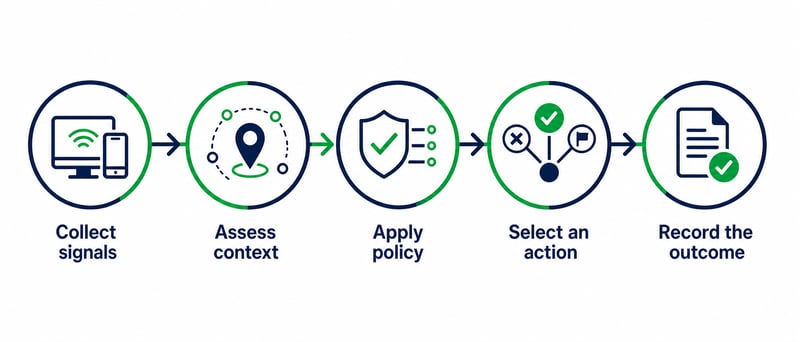
- Collect signals. The system gathers relevant information about the device, location, network, customer behavior, account history, transaction, recipient, and channel.
- Assess context. It compares the current interaction with known patterns and risk indicators. A familiar device and ordinary transfer may carry a different risk profile from a new device and an unusual recipient.
- Apply policy. Rules, risk thresholds, machine learning models, and regulatory requirements help determine the permitted response.
- Select an action. The system may approve, decline, hold, monitor, or trigger step-up authentication.
- Record the outcome. Decision results and customer responses support investigations, policy tuning, reporting, and future risk analysis.
Good decisioning keeps the response proportional. Low-risk activity can use silent or low-effort checks, while elevated risk can trigger stronger authentication or a temporary block.
Which signals inform a fraud decision?
Fraud decisioning uses multiple signal categories because no single data point can describe the full context of an interaction.
| Signal category | Examples | Decision value |
|---|---|---|
| Device | Device identity, operating system, security posture, enrollment status | Shows whether the device is recognized and trusted |
| Behavior | Login patterns, navigation, typing, taps, transaction habits | Highlights deviations from established behavior |
| Transaction | Amount, recipient, merchant, payment type, velocity | Identifies unusual or high-impact activity |
| Environment | Location, IP address, network, time, application or browser context | Adds situational context to the interaction |
| Relationship | Account age, prior activity, trusted devices, recipient history | Shows the strength and history of the customer relationship |
EMVCo explains that device and cardholder information in an EMV 3-D Secure request can assist transaction risk assessment. Its technical guidance also shows why accurate, contextual data affects the issuer’s ability to assess an online payment.
What is the difference between fraud detection and fraud decisioning?
Fraud detection identifies signals associated with suspicious activity, while fraud decisioning determines the response to those signals. Detection is an input to the decision; decisioning is the control action that follows.
| Fraud detection | Fraud decisioning |
|---|---|
| Finds anomalies or risk indicators | Selects an action based on risk and policy |
| May generate a score or alert | May approve, decline, hold, monitor, or challenge |
| Focuses on evidence | Connects evidence to business and security outcomes |
A risk score alone does not protect a customer. The score must feed an understandable policy and a response that fits the risk, customer journey, and regulatory setting.
How is fraud decisioning used in banking and payments?
Fraud decisioning supports decisions across the customer lifecycle, including account access, account changes, money movement, card payments, and digital wallet activity.
Account access and account takeover prevention
At login, decisioning can assess the device, network, location, behavior, and recent account events. A trusted pattern may receive a low-effort authentication path, while a new device combined with unusual behavior can trigger stronger verification.
High-risk account changes
Adding a beneficiary, changing contact details, resetting credentials, or enrolling a device can affect future account access and payment risk. These actions merit their own assessment rather than inheriting trust from an earlier login.
Transfers and real-time payments
Payment decisioning can assess the amount, recipient, transaction velocity, account history, and signs of social engineering. This is especially important for push payments, where a customer may initiate the transfer after being manipulated by a scammer.
Card-not-present payments
In e-commerce, fraud decisioning can combine merchant data, cardholder history, device information, and transaction context. EMV 3-D Secure supports the exchange of this information and can help issuers decide when authentication is necessary.
What is risk-based authentication in fraud decisioning?
Risk-based authentication is an authentication method that changes the verification requirement according to the assessed risk of an interaction. It is one response within a broader fraud decisioning process.
Entersekt’s risk-based authentication guidance describes how device, location, browser, network, behavior, and transaction context can inform a decision. Low-risk activity may proceed with a silent check, while unusual activity can receive step-up authentication.
Risk-based authentication should not be treated as a single score or a fixed challenge rule. Its value comes from connecting relevant signals to clear policies and authentication methods that match the assessed risk.
Why does cross-channel context matter?
Cross-channel context matters because a risk signal in one interaction can change the meaning of a later interaction. For example, a new device registration followed by a payee change and an urgent transfer forms a different risk picture from each event considered separately.
Entersekt’s Context Aware™ Authentication describes a model that evaluates device, location, network, behavior, and transaction context across digital banking and payment journeys. This helps institutions apply a consistent response when activity moves between channels.
Cross-channel decisioning also supports investigation. Analysts can review the sequence of events, the signals involved, the action taken, and the customer’s response rather than examining disconnected alerts.
What should financial institutions consider when implementing fraud decisioning?
Implementation should start with the decisions the institution needs to make, not with a list of data sources. Each decision should have a defined risk objective, accountable owner, permitted responses, and measurable outcome.
- Decision points: Map login, enrollment, account changes, payments, transfers, and recovery journeys.
- Signal quality: Assess accuracy, coverage, provenance, privacy impact, and resilience of each signal.
- Policy governance: Define who can change rules, thresholds, authentication requirements, and exception handling.
- Response design: Match approval, decline, monitoring, hold, and step-up paths to the risk and customer context.
- Operational workflow: Connect decisions to alerts, investigations, case management, and customer support.
- Measurement: Track fraud loss, approval outcomes, challenge rates, customer completion, investigation workload, and recovery results.
- Privacy and explainability: Document data use, retention, access, and the reasons a decision can be reviewed or challenged.
The Federal Reserve’s interagency authentication guidance links authentication controls to risk assessment, layered security, monitoring, logging, and periodic evaluation. Those principles are relevant when decisioning covers both customer access and financial transactions.
How does Entersekt approach fraud decisioning?
Entersekt applies real-time risk intelligence and adaptive authentication across digital banking and payment interactions. Its Authentication Advisor evaluates signals such as device, behavior, transaction, and cross-channel context to help determine an appropriate response.
In practice, that means turning risk signals into operational decisions, including when to approve an interaction, decline it, or request additional verification. This is especially relevant after initial login, when fraud may emerge during account changes or money movement.
It also means aligning fraud decisioning with authentication choice, so institutions can apply controls such as trusted device recognition, behavioral analysis, biometric authentication, or passkeys according to the risk and context of the interaction.
Key takeaways
- Fraud decisioning connects risk evidence to an action.
- Detection identifies suspicious signals; decisioning determines what happens next.
- Useful signals include device, behavior, transaction, environment, and relationship context.
- Risk-based authentication is one response that can be selected by a broader decisioning process.
- Cross-channel context helps institutions recognize how separate events combine into a higher-risk journey.
- Effective programs measure security outcomes alongside customer and operational outcomes.
FAQs about fraud decisioning
➡️ Is fraud decisioning the same as a fraud score?
No. A fraud score summarizes assessed risk, while fraud decisioning uses that risk and other policy inputs to select an action. Entersekt connects real-time risk intelligence to adaptive authentication, helping institutions decide when to approve, decline, monitor, or request stronger verification.
➡️ Can fraud decisioning stop authorized push payment scams?
Fraud decisioning can help identify risk associated with authorized push payment scams, but no control eliminates every scam. Entersekt assesses transaction, behavioral, device, and relationship context to identify unusual activity and apply an appropriate response before a payment is completed.
➡️ Does fraud decisioning replace authentication?
No. Fraud decisioning determines when and how authentication should be used. Entersekt combines risk assessment with authentication methods so trusted activity can follow a low-effort path and higher-risk activity can receive stronger verification.
➡️ What data does fraud decisioning use?
Fraud decisioning can use device, location, network, behavior, transaction, account, and channel data. Entersekt combines these signals to assess the context of a customer interaction and inform a response that matches the risk.
➡️ Why is fraud decisioning important for digital banking?
Fraud decisioning helps protect digital banking journeys beyond the initial login. Entersekt assesses account access, account changes, transfers, and payments so institutions can address risk as it develops across the customer journey.