



The right customer, the wrong circumstances: What behavioral intelligence adds to fraud prevention
JP Blaho, Senior Product Marketing Director


A customer signs in, adds a beneficiary, and approves a payment. The credentials are valid. The device is familiar. Authentication succeeds.
There are still important questions to ask. Is the customer operating the account? Does the journey resemble their usual banking activity? Could someone be directing what they do?
In the first article in this series, we explored why effective protection requires more than one signal. The second article examined device intelligence and the limits of familiarity. Behavioral intelligence adds another perspective: what the interaction itself can reveal.
Recognizing a customer is part of protecting them. Understanding the circumstances surrounding an action matters, too.
Two perspectives on behavior
“Behavioral intelligence” can describe several related capabilities. Separating them helps clarify what each contributes:
-
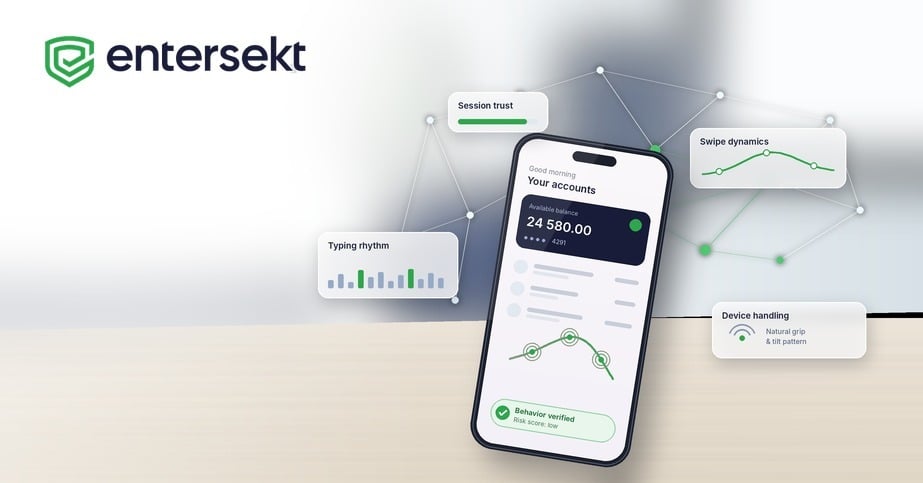
Behavioral biometrics examines how someone interacts with a device or application, including typing rhythms, touch gestures, mouse movements, and, on mobile, how the device is held and moved. These characteristics can help assess consistency with previous interactions or identify patterns associated with automated activity.
-
Session behavior examines how an interaction unfolds: navigation, timing, pauses, corrections, and the sequence of actions. It adds context about the journey through an account.
Both become more meaningful when read against transaction patterns: amounts, recipients, frequency, timing, and departures from previous payment habits. The practical distinction is between how someone interacts, what they do during a session, and how the resulting activity fits a broader financial pattern. These perspectives overlap, and vendors may group them differently.
Availability also varies. A mobile app and a browser may expose different signals, and a new customer may have little history against which to compare them. Institutions need to understand both the evidence available and the limits of the assessment.
Same account, different concerns
Consider an attacker who has obtained access to a customer’s account.
The attacker may know the credentials but interact differently from the account holder. They might navigate directly to payment functions, change contact details, or move quickly through beneficiary setup. Behavioral biometrics could indicate a departure from previous interactions. The sequence of account changes and payment activity could strengthen the concern.
That can hold even when the attacker is working through the customer’s own familiar device. If a remote-access tool is in use, the typing, movement, and navigation come from someone else, difference behavioral biometrics may detect even when device recognition offers reassurance.
None of those observations establishes account takeover on its own. A legitimate customer might also be in a hurry or updating several details. But combined with device evidence, authentication history, and the payment being attempted, they can give the institution a reason to investigate or require additional assurance.
Now consider the genuine customer making a payment while speaking to someone impersonating a bank employee.
The customer’s typing and touch patterns may remain recognizable. They are using their own account and personally approving each step. Here, the concern tends to show up less in how the customer interacts than in what the session does. It might include unusual pauses, repeated edits, or movement between screens as they follow instructions. A substantial payment to a new recipient could add concern.
Those patterns cannot establish that a scammer is on the phone. They may, however, contribute to a risk assessment that deserves a different response.
In the first scenario, the institution needs to address possible unauthorized control. In the second, it needs to help a recognized customer reconsider an action they have been persuaded to take.
Behavior provides evidence, not access to intent
It is tempting to describe behavioral intelligence as understanding what a customer is thinking. That overstates what the technology can establish.
A pause is observable. Its explanation is not.
The customer could be listening to a scammer, checking an invoice, answering the door, or working out how a redesigned payment screen works. Repeated corrections might reflect coaching, unfamiliarity, an accessibility need, or a difficult afternoon.
The same restraint applies to reassuring behavior. A smooth, familiar interaction does not establish that a payment is safe. A deceived customer may act confidently because the scammer’s explanation seems convincing.
Behavioral intelligence is useful when it changes the weight of the evidence. Its contribution becomes stronger when assessed alongside the account history, device environment, transaction patterns, and the action being attempted.
Automation adds another dimension
Behavior can also help identify activity that appears automated. Highly repetitive interactions, unusually consistent timing, or sequences performed at implausible speed may warrant attention.
But speed alone is a poor basis for a decision. Password managers, autofill, assistive technologies, and experienced customers can all change how an interaction looks. Increasingly, so will AI agents acting with a customer’s permission. Malicious automation may also introduce variation to appear more human.
Institutions should therefore assess automation indicators in context, including patterns across sessions and accounts where available. The useful question is not simply whether activity is automated, but whether it creates risk in that particular journey.
Better understanding should lead to better protection
The distinction between an attacker and a coached customer becomes especially important when choosing an intervention.
For suspected account takeover, an institution may need to restrict sensitive changes, verify control through a trusted authenticator, or initiate recovery.
For suspected scam influence, asking the customer to approve another prompt may do little. The customer already believes the payment is necessary. A targeted warning, questions about the payment’s purpose, or an opportunity for review may offer more useful protection.
These are possible responses, not automatic consequences of a behavioral anomaly. Their suitability depends on the combined evidence and the institution’s ability to act while help is still possible.
At Entersekt, we see value in connecting behavioral context to authentication and payment decisions throughout the journey. Behavioral intelligence proves its worth when it helps an institution choose a more effective response.
Give behavioral intelligence a clear role
For institutions evaluating this layer, three questions are useful:
-
Which behavioral signals can we observe reliably, and where do we lack sufficient history or visibility?
-
Can our assessments distinguish concerns about account control from concerns about a customer being manipulated?
-
Can we show improved protection without creating unnecessary interruptions, including for customers with different interaction needs?
Behavioral data also calls for particular care. In some jurisdictions, behavioral characteristics used to identify a person can be treated as biometric data, with stricter requirements attached. Collection should serve a defined purpose, with appropriate privacy controls and limited retention, and each additional signal should have a clear connection to better decisions.
Behavioral intelligence can help institutions recognize when an interaction deserves closer attention, even when identity and device checks provide reassurance. It cannot settle every question about who is acting or why.
That leaves the next challenge in this series: once the evidence raises concern, what intervention will help? Stay tuned.