







Every online card payment tests an issuer’s ability to stop fraud without getting in the cardholder’s way. Unnecessary challenges can interrupt checkout, while false declines can send legitimate customers to another card. Stronger security should not mean a harder payment experience.
This article explores how issuers can combine richer transaction data, risk-based decisioning, and EMV 3-D Secure to authenticate trusted cardholders with less friction and apply additional verification when needed. It also sets out practical steps for improving payment authentication and measuring the results now, in 2026, and beyond.
Why issuers cannot afford to ignore false declines
A legitimate payment rejected by fraud controls is more than a missed transaction. It can interrupt a purchase, prompt a support call, and give a cardholder a reason to reach for a competing card. For issuers, the cost extends from lost transaction revenue to weaker customer relationships and a smaller share of spend.
A 2025 PYMNTS Intelligence report found that 47% of retailers cited false declines as having a severely negative impact on customer satisfaction. That is a merchant-side finding, but it highlights the checkout disruption issuers must consider alongside fraud losses.
The answer is not simply to loosen fraud controls. It is to distinguish trusted payments from suspicious activity more accurately, so that reducing false declines does not come at the expense of security. Authentication decisions should support that goal without adding unnecessary challenges.
Match authentication to the transaction’s risk
Consider a cardholder buying their weekly groceries online from a familiar device. If the transaction and available risk signals are consistent with their usual activity, the issuer may authenticate them without asking for a code or confirmation. This is the frictionless flow. If the same account is then used for an unusually large purchase from an unfamiliar device, additional verification may be appropriate: the challenge flow.
EMV 3-D Secure enables the issuer’s Access Control Server (ACS) to evaluate the available authentication data and determine the appropriate response. When a challenge is needed, the issuer can ask the cardholder to verify the payment through a supported method, such as their banking app. Successful authentication does not itself guarantee payment authorization; that remains a separate decision.
The objective is not to maximize frictionless authentication at any cost. It is to remove unnecessary interruptions while applying additional verification where risk or applicable requirements warrant it. Entersekt’s 3-D Secure ACS supports risk-aware authentication and configurable cardholder journeys.
Use richer context to make better decisions
A transaction amount or unfamiliar location tells only part of the story. Device familiarity, account history, behavioral patterns, and merchant and transaction information can give the issuer a more useful basis for deciding whether additional verification is needed.
These signals work together. An unfamiliar device alone does not establish fraud, just as a recognized device does not guarantee a legitimate payment. Behavioral anomalies, recent account changes, and other relevant risk indicators can help distinguish a genuine cardholder in a new situation from suspicious activity involving compromised credentials.
Data quality matters as much as data volume. Issuers should assess which signals their ACS actually receives, how reliable those signals are, and whether relevant intelligence from digital banking or external risk services can improve decisioning. Entersekt’s Context Aware™ Authentication brings context into the authentication journey so that the response can reflect the interaction rather than a blanket rule.
Connect better authentication experiences to commercial outcomes
When legitimate cardholders can complete purchases without avoidable interruptions, issuers have a stronger foundation for repeat card use and customer trust. Capitec provides a concrete example: working with Entersekt, the South African retail bank streamlined its 3-D Secure journey and reported improvements in conversion rates and transaction value.
These results illustrate the commercial value of improving the authentication experience, not a guaranteed outcome for every issuer. Evaluate changes against your own fraud exposure, cardholder behavior, and portfolio performance.
Evaluate your ACS against the decisions you need to improve
Start with three questions:
-
Can your platform use relevant risk signals and let you calibrate policies by portfolio or market?
-
Can it offer appropriate step-up methods without creating unnecessary obstacles for cardholders?
-
And can your team measure authentication outcomes alongside fraud and payment performance?
Use those answers to prioritize implementation. Audit existing rules, improve the data feeding your decisions, and test changes against historical outcomes before expanding them. Monitor frictionless rates, challenge completion, false declines, and fraud together: a better result in one metric should not conceal deterioration in another.
The roadmap below summarizes the areas to address and revisit as your strategy develops.
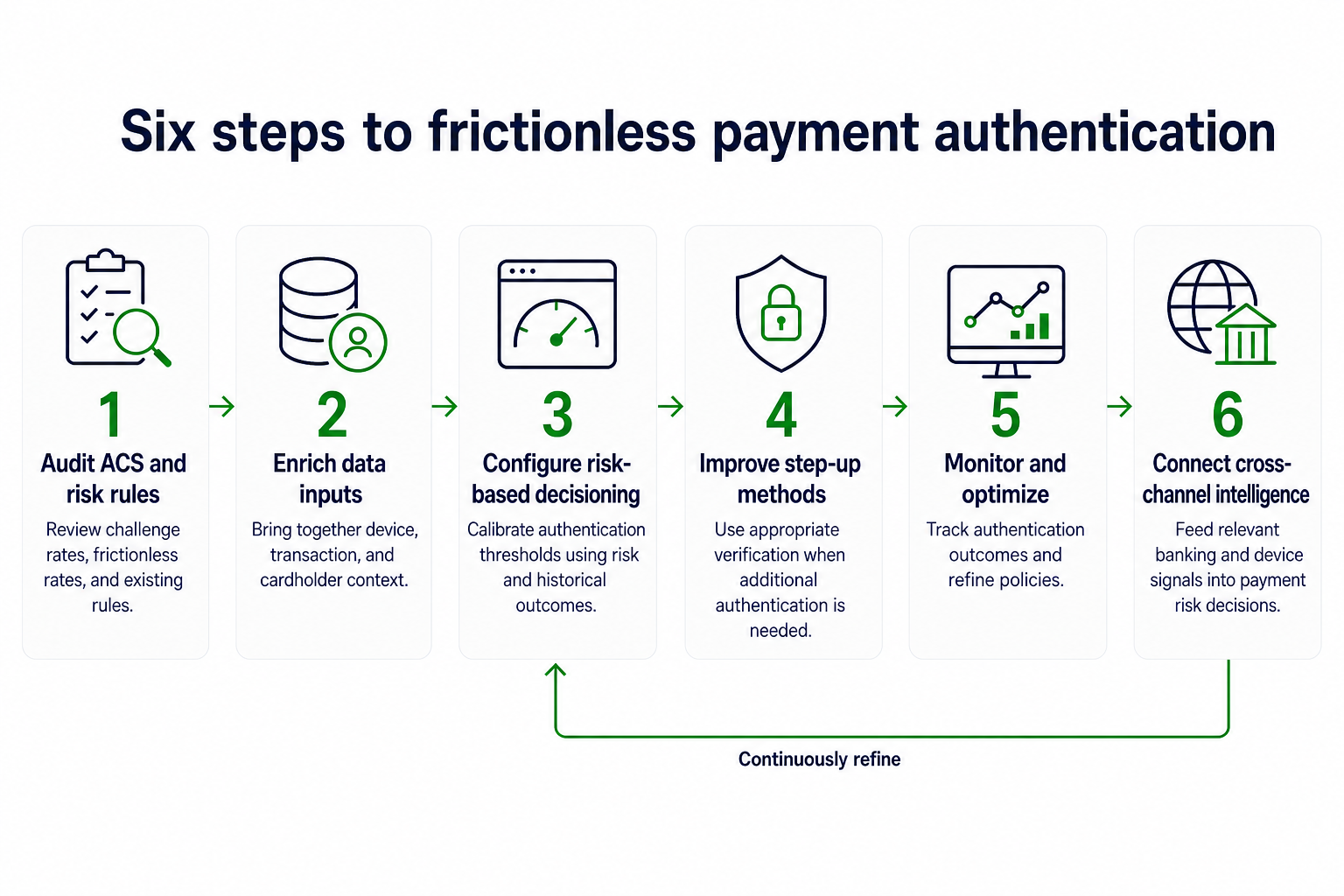
Explore how Entersekt’s Authentication Advisor and 3-D Secure solutions support risk-aware authentication, with configurable authentication journeys that can be refined over time.
Make authentication work for security and growth
Frictionless payment authentication is not about removing every check. It is about using context to recognize trusted activity, verify cardholders when needed, and keep improving the decisions behind each journey. Focus on fewer avoidable interruptions and stronger fraud controls together, then measure what changes for your cardholders and your business.
Explore Entersekt’s 3-D Secure solution to see how issuer authentication can support that strategy.