








OTP bots are automated fraud tools used to help attackers obtain one-time passwords (OTPs) from customers, often through real-time social engineering. They can automate parts of an attack by triggering an authentication request and then contacting the victim through a phone call, text message, messaging platform or other channel while impersonating a trusted organisation.
OTP bots are particularly concerning for financial institutions because they can exploit a fundamental weakness in OTP-based authentication: the authentication system may successfully verify that the correct OTP was entered without being able to determine whether the customer was manipulated into providing it.
How do OTP bots work?
A typical OTP bot attack can involve several stages:
- Credentials are obtained
The attacker obtains a customer's username and password, often through phishing, credential theft or another compromise. - The attacker initiates an authentication event
The attacker attempts to log in or perform another protected action, causing the legitimate service to send an OTP to the customer. - The OTP bot contacts the victim
The bot may automatically call or message the customer while impersonating the bank, merchant or service provider. - The customer is socially engineered
The attacker creates urgency or provides a convincing explanation for why the customer needs to provide the code. - The customer discloses the OTP
The attacker captures the temporary authentication code. - The attacker uses the OTP in real time
The attacker enters the code into the legitimate service and attempts to complete the account takeover, payment or other fraudulent action.
The defining characteristic is the real-time relationship between the authentication event and the social-engineering interaction.
OTP bots vs phishing
OTP bots and phishing are related but not identical.
Phishing generally refers to deceptive communications or websites designed to obtain sensitive information.
An OTP bot is an automated tool that can facilitate a more dynamic attack, including triggering an authentication event and interacting with the victim while the OTP is valid.
An OTP bot can therefore be part of a broader phishing or social-engineering campaign.
Why are OTP bots a threat to MFA?
OTP-based MFA is designed to add a second layer of protection beyond a username and password.
However, MFA can be undermined when an attacker persuades the legitimate customer to provide the second factor.
This is why authentication security cannot depend exclusively on whether the correct OTP has been entered. A stronger approach evaluates the context around the authentication event, including the device, behaviour, session, transaction and other available risk signals.
What types of fraud can OTP bots enable?
OTP bot attacks can contribute to:
- Account takeover (ATO)
- Payment fraud
- Card-not-present fraud / CNP Fraud
- Unauthorised account changes
- Credential theft
- Transaction manipulation
- Social-engineering scams
- Customer-initiated fraudulent transactions
The exact outcome depends on what the attacker has already compromised and what the stolen OTP authorises.
How can financial institutions detect OTP bot attacks?
No single signal reliably identifies every OTP bot attack. Financial institutions can combine multiple indicators, including:
-
Authentication behaviour
Unusual login patterns, repeated authentication attempts or authentication events inconsistent with a customer's normal behaviour can increase risk.
-
Device intelligence
Information about the device identity, the application, browser, and environment can help identify unfamiliar or suspicious devices.
-
Behavioural intelligence
How a customer interacts with a digital service can provide additional evidence about whether the session resembles legitimate behaviour or automation.
-
Transaction context
A high-risk payment immediately following a suspicious login or authentication event may warrant additional scrutiny.
-
Network and location signals
Changes in network, location or other environmental characteristics can contribute to a broader risk assessment.
-
Automation indicators
Bots may exhibit unusual timing, interaction patterns or other characteristics that distinguish automated activity from genuine customer behaviour.
The strongest detection strategy combines these signals rather than treating the OTP itself as the primary fraud signal.
How can banks protect customers from OTP bots?
Financial institutions can reduce OTP bot risk by combining customer education with stronger, context-aware security controls.
Useful measures include:
- Detecting suspicious authentication and transaction behaviour
- Monitoring device and session risk
- Applying risk-based authentication
- Using step-up authentication for higher-risk events
- Using phishing-resistant authentication where appropriate
- Detecting automation and bot activity
- Providing customers with clear transaction context
- Monitoring for unusual account changes and payment behaviour
- Limiting or reviewing suspicious authentication attempts
The goal should be risk-proportionate authentication rather than adding friction to every customer interaction.
OTP bots and account takeover
OTP bots are particularly relevant to account takeover (ATO) because attackers can combine stolen credentials with social engineering to overcome an OTP challenge.
A typical attack chain can look like:
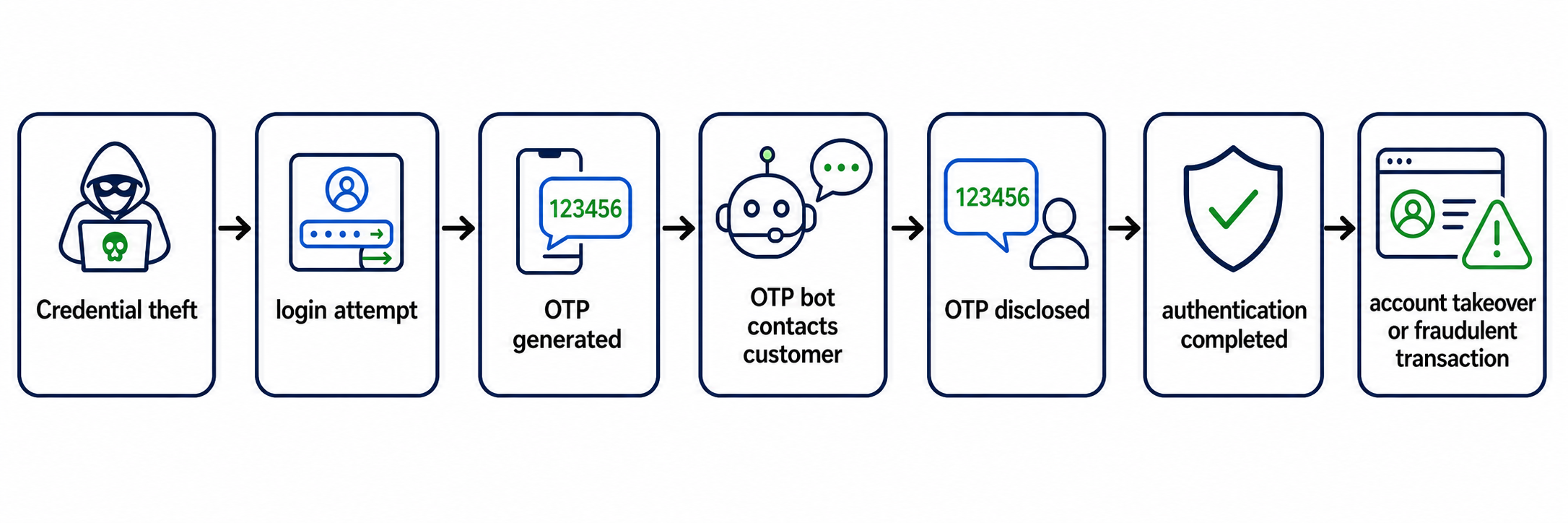
Breaking this chain at any point can reduce the likelihood of successful fraud. For example, detecting an unfamiliar device or abnormal behavioural pattern before the OTP is requested can enable the financial institution to increase scrutiny before the attacker reaches the customer.
Are OTP bots the same as bot attacks?
Not necessarily.
A bot attack is a broad category of automated activity performed by software. An OTP bot specifically facilitates attacks involving one-time passwords, often by helping attackers socially engineer victims into revealing authentication codes.
OTP bots can therefore be considered a specialised type of automated fraud tool.
How does risk-based authentication help against OTP bots?
Risk-based authentication evaluates the context of an authentication event rather than relying exclusively on a single authentication factor. For example, a financial institution might consider:
- Is this a known device?
- Is the login behaviour consistent with the customer?
- Is the session behaving normally?
- Is the location or network unusual?
- Has the account recently undergone a sensitive change?
- Is the transaction consistent with the customer's normal behaviour?
- Are there indicators of automation?
If the combined risk is low, the customer can receive a low-friction experience. If risk is elevated, the institution can require stronger authentication, additional verification or block the action.
Can OTP bots bypass MFA?
OTP bots can help attackers defeat OTP-based MFA when the customer is successfully manipulated into revealing the OTP. This does not mean that all MFA is ineffective; it demonstrates why authentication factors should be supported by risk signals and, where appropriate, phishing-resistant authentication.
Key takeaway
OTP bots exploit the gap between authenticating a code and authenticating intent. A financial institution may correctly verify that the OTP is genuine while the underlying transaction is still fraudulent because the customer was manipulated into providing the code.
Modern fraud prevention therefore needs to look beyond the OTP itself and evaluate who is acting, what they are doing, from which device, in what context, and with what level of risk.
FAQs
What is an OTP bot?
➡️ An OTP bot is an automated fraud tool used to help attackers obtain one-time passwords, often by facilitating real-time social engineering.
How does an OTP bot attack work?
➡️ An attacker initiates an authentication event, causing an OTP to be sent to the victim, and the bot then attempts to persuade the victim to disclose the code.
Can OTP bots bypass MFA?
➡️ They can undermine OTP-based MFA when a customer is manipulated into giving the attacker the authentication code.
What is the difference between an OTP bot and phishing?
➡️ Phishing is a broad category of deceptive attacks. An OTP bot is a specialised automated tool that can facilitate real-time attacks against OTP authentication.
Can OTP bots steal OTPs automatically?
➡️ They can automate parts of the attack, but many OTP bot attacks still rely on social engineering the customer into revealing the code.
What fraud can OTP bots cause?
➡️ OTP bot attacks can contribute to account takeover, payment fraud, unauthorised account changes and other forms of digital fraud.
How can banks detect OTP bot attacks?
➡️ Banks can combine device intelligence, behavioural signals, authentication patterns, transaction context, network information and automation indicators to assess risk.
How can customers protect themselves from OTP bots?
➡️ Customers should never disclose an OTP to someone who contacts them. They should verify unexpected authentication requests through their bank's official channel authentication process or a trusted banking app.
Are OTP bots a type of malware?
➡️ Not necessarily. An OTP bot is generally an automated fraud tool or service used to facilitate attacks; it does not have to infect the victim's device.
What is the best defence against OTP bots?
➡️ A layered approach combining risk-based authentication, behavioural and device intelligence, strong transaction controls and phishing-resistant authentication can provide stronger protection than relying on OTP verification alone.