




A remote access Trojan (RAT) is malware that gives an attacker unauthorized remote access to and control over a computer or mobile device. Once installed, a RAT may let the attacker observe activity, steal data, execute commands, manipulate files, capture screens or use the device to commit fraud.
RATs are especially serious in financial services because they can compromise a trusted device and operate inside an apparently legitimate banking session. A customer may pass a login check while an attacker is viewing or controlling the device in the background. Preventing the resulting fraud therefore requires more than checking credentials or device reputation at login.
What is a remote access Trojan?
The name describes both the method and the purpose:
- Remote access: the malware creates a channel through which an attacker can interact with the infected device.
- Trojan: the malware is commonly disguised as legitimate software, a document, an application update or another trusted file so that the victim installs or runs it.
A RAT is not the same as legitimate remote support software. Tools such as remote monitoring and management software can support IT administration, troubleshooting and business continuity. The difference is authorization, transparency and control. A RAT is installed or operated without the victim’s informed consent and is intended to provide an attacker with hidden or unauthorized access.
How does a RAT work?
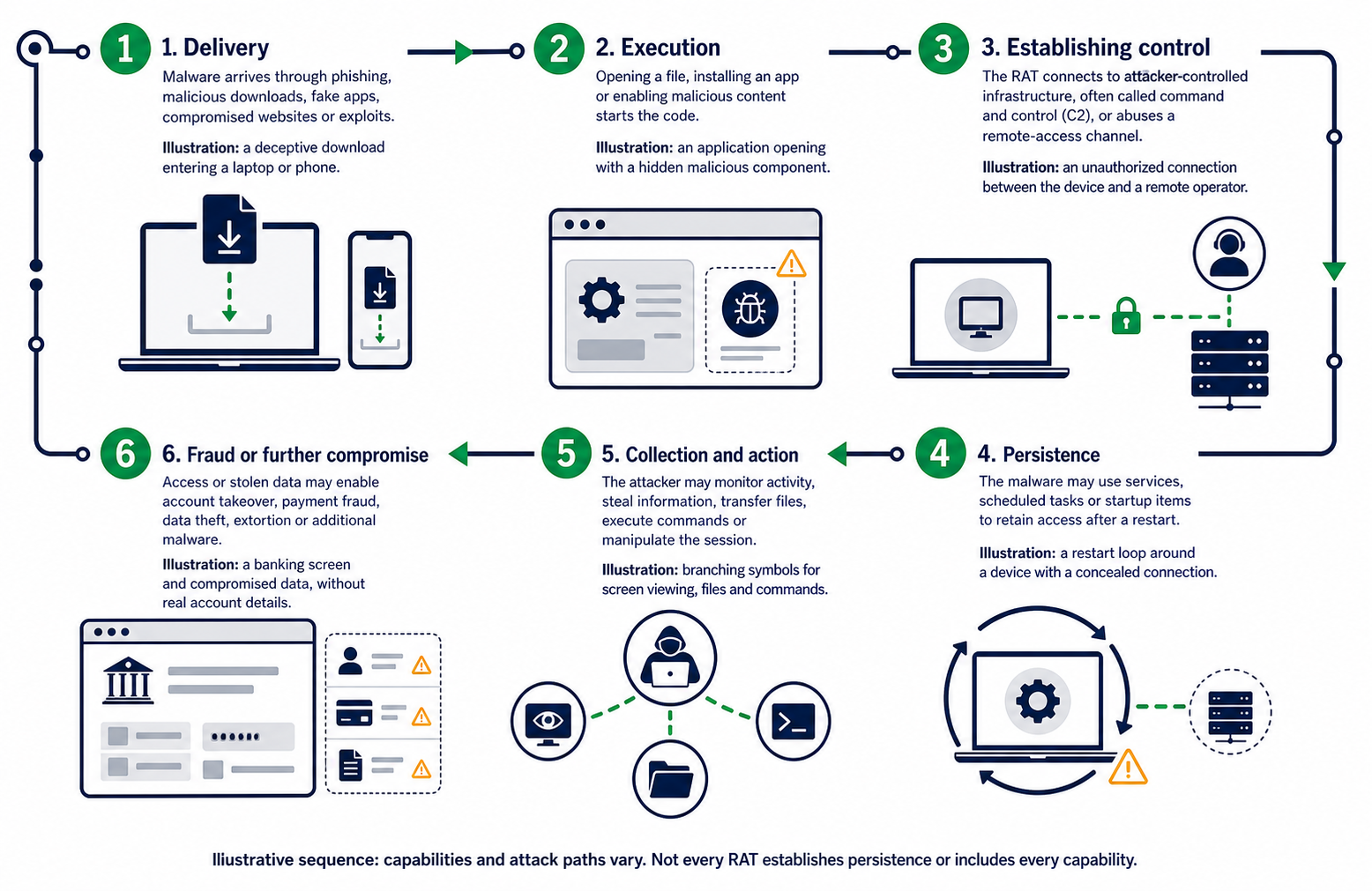
MITRE ATT&CK documents the abuse of legitimate remote access tools as technique T1219. These tools can provide an interactive command-and-control channel and may be used after an initial compromise as an alternative route into a system. This is one reason a malicious remote-access attack may not look like a conventional malware infection.
What can a RAT do?
The functionality depends on the malware and the attacker’s objectives. Common capabilities include:
| Capability | Potential impact |
|---|---|
| Screen capture or live viewing | Exposes banking activity, authentication prompts, documents and other sensitive information. |
| Keyboard or input monitoring | Can capture credentials, payment details and other information entered by the victim. |
| File access and transfer | Allows attackers to steal documents or place additional malware on the device. |
| Command execution | Enables changes to the device, security settings or user environment. |
| Notification or message interception | May expose authentication messages, alerts and transaction notifications on mobile devices. |
| Session manipulation | Can allow an attacker to interfere with a customer’s activity while the customer believes the session is under control. |
| Persistence | Helps the attacker retain access after a restart or reconnect. |
Not every RAT includes every capability. The important point is that the attacker may gain access to the same device, applications and information that the legitimate user can access.
How are RATs delivered?
RATs can arrive through phishing messages, fake apps or updates, malicious installers and browser extensions, compromised websites, or exploited software vulnerabilities. Attackers often impersonate trusted organizations to persuade users to install them.
Microsoft has documented fake rewards apps carrying Android malware that could intercept authentication notifications. Use trusted sources for banking apps and treat unexpected requests to install software or grant remote control as high risk.
Why are RATs a risk to banking and payments?
RATs can undermine controls that rely mainly on a login event, a known device or a valid authentication code. If the attacker controls the customer’s device, the device may appear familiar. The session may use the customer’s normal network and location. The customer may also be present and interacting with the device, sometimes while being coached or deceived by the attacker.
This creates several risks for financial institutions:
- Account takeover: attackers may access accounts, change account details, add beneficiaries or reset credentials.
- Payment fraud: attackers may initiate card, account-to-account, wire or other payments from an authenticated session.
- Authentication compromise: malware may expose push requests, messages, codes or other approval information.
- Customer manipulation: a fraudster may use remote control to guide a customer through actions that appear legitimate to the bank.
- Loss of trust: customers may hold the institution responsible when a compromised device is used to authorize fraudulent activity.
A valid authentication result answers an important question: whether the presented factor or authenticator was accepted. It does not always answer whether the device is under the customer’s exclusive control or whether the customer understands and intends the transaction.
RATs, remote access tools and device takeover
These terms are related but not interchangeable:
| Term | Meaning |
|---|---|
| Remote access Trojan (RAT) | Malware designed to provide unauthorized remote access or control. |
| Remote access software | Legitimate software that enables remote administration or support, but which can be abused by attackers. |
| Remote-access attack | An attack in which a criminal uses malware, legitimate remote access software or social engineering to control or observe a victim’s device. |
| Device takeover fraud | Fraud that occurs when criminals gain control of a user’s device and use it to conduct unauthorized activity. |
| Account takeover fraud | Fraud that occurs when criminals gain control of a legitimate online account, whether through a compromised device, stolen credentials or another method. |
A remote-access attack does not always involve a traditional RAT. For example, a fraudster may persuade a victim to install legitimate remote support software and then use it to view or control the device. CISA has warned that legitimate remote monitoring and management software can be abused for persistence, command and control and financial theft.
How can organizations reduce RAT risk?
No single control eliminates the risk. Effective protection combines endpoint, identity, network, customer and transaction controls.
Reduce the chance of infection
|
Secure remote access
|
Protect banking sessions and transactions
|
For a broader view of how identity, device and transaction signals work together, see Entersekt’s guidance on layered authentication for banks.
What should a customer do if a RAT is suspected?
If a device may be infected or under unauthorized remote control:
- Disconnect it from the internet if doing so will not create additional risk.
- Use a separate, trusted device to contact the bank, employer or relevant service provider.
- Ask the bank to secure the account, review recent activity and stop or recall suspicious payments where possible.
- Change credentials from a clean device and revoke unfamiliar sessions or devices.
- Remove unauthorized software or reset the device according to guidance from a qualified security professional.
- Preserve relevant evidence and report the incident to the appropriate national cybercrime or law-enforcement authority.
|
Use a separate, trusted device to seek help. A compromised device may display misleading information, intercept messages or interfere with security software. Do not use it to confirm that an account or payment is safe. |
Frequently asked questions
➡️ Is a RAT a virus?
A RAT is a type of malware, but it is not necessarily a virus. A virus typically replicates by infecting other files or systems. A RAT’s defining feature is unauthorized remote access and control.
➡️ Can a RAT steal banking information?
Yes. Depending on its capabilities, a RAT may capture screens, monitor input, access files, intercept notifications or control a banking session. The resulting risk depends on the malware, the device and the attacker’s actions.
➡️ Can multifactor authentication stop a RAT?
Multifactor authentication can make unauthorized access more difficult, but it cannot stop every RAT-enabled attack. Malware may expose authentication prompts or codes, and a fraudster may manipulate a customer into approving an action. Phishing-resistant authentication, device security and transaction-aware risk controls provide additional protection.
➡️ What is the difference between a RAT and spyware?
Spyware is designed primarily to observe or collect information. A RAT can include spyware capabilities, but it also provides interactive remote control and command execution.
➡️ Are legitimate remote access applications always dangerous?
No. Legitimate remote access applications support valuable IT and customer-service functions. They become a security risk when installed without authorization, used outside approved processes or controlled by an attacker. Organizations should govern, monitor and limit them rather than assume that the application name alone proves malicious intent.
Sources and related articles
- CISA and ACSC: 2021 Top Malware Strains
- CISA, NSA and MS-ISAC: Protecting Against Malicious Use of Remote Monitoring and Management Software
- CISA: Guide to Securing Remote Access Software
- MITRE ATT&CK: Remote Access Tools, technique T1219
- Microsoft Threat Intelligence: Android malware with RAT capabilities
Related Entersekt resources: device takeover fraud, man-in-the-middle attacks, one-time passwords and layered authentication for banks.