





Mobile banking authentication is the process of verifying that the person accessing a bank account or authorizing a banking action is the legitimate customer. It uses one or more authentication factors, such as a trusted mobile device, biometrics, a PIN, passkey or cryptographic credential, to establish that a customer is authorized to access an account or perform a transaction.
Modern mobile banking authentication increasingly combines device identity, biometrics, cryptographic authentication, behavioural and risk signals, and transaction context rather than relying solely on passwords or SMS one-time passwords (OTPs).
What is mobile banking authentication?
Mobile banking authentication verifies a customer's identity when they access a banking service through a mobile device or when they use a mobile device to authenticate an action initiated through another channel. It can be used to:
-
Authenticate mobile banking app logins and higher-risk activity
-
Confirm transactions, transfers, and new beneficiaries
-
Verify account changes, password resets, and recovery
-
Confirm device registration or re-enrollment
-
Protect sensitive account information
Mobile banking authentication is therefore broader than simply logging into a banking app. Modern authentication can protect the entire digital banking journey, from account access to high-value transactions and account recovery.
How does mobile banking authentication work?
A mobile banking authentication process generally involves three stages:
- Identify the customer or device – The bank establishes which customer and device are involved.
- Evaluate authentication evidence and risk – The bank evaluates authentication factors and contextual signals to determine whether the request is legitimate.
- Authenticate or challenge the customer – The customer is authenticated silently or through an explicit action such as biometric verification, a passkey, PIN, secure push notification or another authentication method.
The exact architecture varies between financial institutions. A modern mobile banking authentication platform may combine:
Customer identity + device identity + authentication factor + transaction context + risk signals = authentication decision
This approach allows banks to apply stronger controls when risk is elevated while reducing unnecessary friction for legitimate customers.
Mobile authentication vs. mobile banking authentication
The terms mobile authentication and mobile banking authentication are closely related but are not identical.
- Mobile authentication is the broader concept of using a mobile device as part of an authentication process. It can apply to banking, commerce, enterprise applications and other digital services.
- Mobile banking authentication specifically refers to authentication used to protect banking services and financial interactions.
Mobile banking authentication therefore has additional requirements because the authentication process may need to protect not only account access but also money movement, payment authorization, sensitive account changes and other high-risk actions.
Why is mobile banking authentication important?
Mobile banking has become a primary channel for accessing financial services. This makes mobile devices an important part of both customer experience and financial security.
At the same time, attackers increasingly target mobile channels through a wide range of fraud and attack techniques, including:
-
Account-based attacks: Account takeover (ATO), credential theft, session hijacking
-
Social engineering attacks: Phishing, smishing, vishing, impersonation
-
Device-based attacks: SIM-swap attacks, device compromise, malware and banking trojans, remote-access attacks
-
Interception attacks: Man-in-the-middle attacks
A strong mobile banking authentication strategy helps financial institutions distinguish legitimate customers from unauthorized users while keeping authentication proportionate to the level of risk.
Mobile banking authentication methods
Financial institutions can use a combination of authentication methods to protect mobile banking accounts and transactions. Common approaches include:
|
Authentication method |
How it works |
|
Device authentication |
Uses a trusted mobile device or device identity as part of the authentication process. |
|
Biometric authentication |
Uses fingerprints, facial recognition or other biometric factors to verify the customer. |
|
Passkeys and FIDO |
Uses cryptographic credentials to provide passwordless, phishing-resistant authentication. |
|
Push authentication |
Sends an authentication request to a registered banking app for the customer to approve or reject. |
|
Out-of-band authentication |
Authenticates a customer through a separate channel, such as a secure banking app. |
|
SMS OTP |
Sends a temporary one-time password by SMS. While widely used, SMS OTPs can be vulnerable to phishing and SIM-swap attacks. |
|
Risk-based authentication |
Uses signals such as device, behaviour, location and transaction context to determine whether additional authentication is required. |
Banks increasingly combine these methods with device intelligence, risk signals and transaction context rather than relying on a single authentication method. This allows financial institutions to apply stronger authentication when risk is higher while reducing unnecessary friction for legitimate customers.
Mobile banking authentication and multi-factor authentication
Mobile banking authentication can form part of a multi-factor authentication (MFA) strategy.
MFA requires authentication using multiple independent factors.
The traditional factor categories are:
|
Factor |
What it means |
Banking example |
|
Knowledge |
Something the customer knows |
Password or PIN |
|
Possession |
Something the customer has |
Registered device or security key |
|
Inherence |
Something the customer is |
Fingerprint or facial recognition |
The European Banking Authority identifies knowledge, possession and inherence as the three authentication elements relevant to strong customer authentication under PSD2.
Mobile authentication can contribute a possession factor through a trusted device and can also incorporate an inherence factor through biometrics.
Importantly, using a mobile phone does not automatically make an authentication method MFA. The authentication architecture must satisfy the applicable requirements for independent authentication factors.
Mobile banking authentication and passkeys
Passkeys provide a passwordless approach to mobile banking authentication using public-key cryptography. The private key remains protected on the customer's device, while the bank stores the corresponding public key. Customers can typically unlock a passkey using a biometric, PIN or device authentication.
Based on FIDO standards, passkeys are designed to provide phishing-resistant authentication without sharing biometric information with the bank.
Mobile banking authentication and transaction authorization
Authentication and transaction authorization are related but serve different purposes:
- Authentication: Is this the legitimate customer?
- Transaction authorization: Is the customer intentionally approving this specific action?
A customer can be successfully authenticated but still be manipulated into approving a fraudulent transaction. Banks can therefore combine authentication with transaction context, risk intelligence and additional verification for higher-risk actions such as large transfers, new beneficiaries, device registration or account changes.
What fraud does mobile banking authentication help prevent?
Mobile banking authentication can help reduce the risk of unauthorized access and fraud, including:
|
Fraud or threat |
How authentication can help |
|
Account takeover (ATO) |
Strong authentication makes stolen credentials harder to use for unauthorized account access. |
|
SIM-swap fraud |
Device-bound and cryptographic authentication can reduce reliance on SMS-based authentication. |
|
Phishing |
Passkeys and other phishing-resistant authentication methods can make stolen credentials less useful to attackers. |
|
Social engineering |
Risk-based authentication and transaction context can help identify unusual or higher-risk activity. |
|
Malware and remote-access attacks |
Device intelligence, behavioural signals and risk analysis can help detect suspicious device or session activity. |
Authentication is most effective when combined with device intelligence, fraud detection and transaction risk analysis. No single authentication method can prevent every type of fraud.
Mobile banking authentication vs. behavioural biometrics
These technologies address different aspects of authentication and fraud prevention.
- Mobile banking authentication establishes or verifies a customer's identity using one or more authentication mechanisms.
- Behavioural biometrics analyses how a person interacts with a device or digital service, such as typing, navigation, mouse movements or touchscreen behaviour.
Behavioural signals can operate continuously in the background and contribute to risk assessment without requiring an explicit authentication action.
This creates an important distinction:
Authentication verifies identity at specific points; behavioural signals can provide continuous evidence about whether activity appears consistent with the legitimate customer.
Mobile banking authentication vs. device identity
Mobile banking authentication verifies that a customer is authorized to access their account or perform a high-risk action. Device identity adds another layer of context by identifying the device being used and helping establish whether it is known and trusted.
A trusted device can therefore become an important part of the authentication journey. For example, a customer can register their mobile device and use it to approve a login or transaction, while the financial institution uses device identity alongside other signals to assess risk.
By combining customer authentication, device identity, and risk signals, banks can recognize trusted interactions and provide low-friction authentication, while applying stronger verification when a customer uses a new or unfamiliar device or when other risk signals change.
What makes mobile banking authentication secure?
A strong mobile banking authentication strategy should consider more than the authentication method itself.
Key considerations include:
|
Security consideration |
Why it matters |
|
Phishing resistance |
Authentication mechanisms should reduce the ability of attackers to capture and reuse authentication credentials. |
|
Device binding |
The bank should be able to establish whether an authentication request originates from a recognized and trusted device. |
|
Cryptographic protection |
Cryptographic authentication can provide stronger protection than shared secrets such as passwords and OTPs. |
|
Risk-based controls |
Authentication should respond to changes in risk rather than applying identical friction to every interaction. |
|
Transaction context |
Customers should be able to understand what they are being asked to approve, particularly for high-value transactions. |
|
Secure recovery |
Lost devices, compromised credentials and device changes create recovery risks. Account recovery should therefore receive the same level of security consideration as initial authentication. |
|
Customer experience |
Security controls that create excessive friction can encourage customers to abandon journeys or seek insecure workarounds. The objective is not simply to add more authentication. It is to provide appropriate authentication at the appropriate moment. |
10 Mobile banking authentication best practices
Financial institutions evaluating mobile banking authentication should consider the following practices:
- Move beyond passwords and SMS OTPs where appropriate.
- Use device identity as part of a broader authentication architecture.
- Adopt phishing-resistant authentication such as FIDO-based passkeys for suitable use cases.
- Use biometrics to provide convenient local authentication.
- Apply risk-based or context-aware authentication to higher-risk interactions.
- Secure transaction authorization, not only account login.
- Protect device registration and account recovery.
- Use descriptive authentication prompts so customers understand what they are approving.
- Monitor for device, behavioural and transaction anomalies.
- Design authentication around both security requirements and customer experience.
Mobile banking authentication and regulatory requirements
Mobile banking authentication requirements vary by jurisdiction, payment type and use case. Financial institutions should ensure their authentication approach meets the regulations and security standards applicable to their markets.
Key frameworks include:
- PSD2 and Strong Customer Authentication (SCA): In the EU, relevant electronic payments may be subject to SCA requirements based on multiple authentication factors, with specific exemptions applying in certain circumstances.
- FIDO2 and WebAuthn: Open standards supporting public-key cryptographic authentication and the technology behind passkeys.
- NIST Digital Identity Guidelines: Guidance covering digital identity, identity proofing and authentication.
Banks should assess authentication methods against applicable regulatory requirements rather than assuming that a particular technology automatically meets compliance obligations.
Mobile banking authentication architecture
A modern mobile banking authentication architecture may include several interconnected layers:
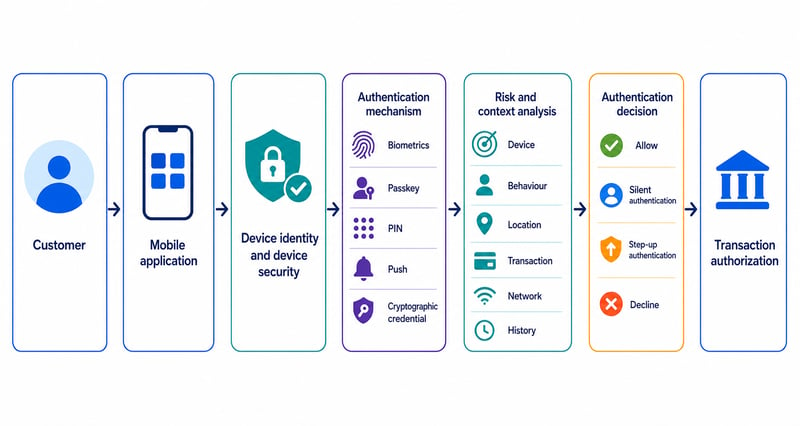
This layered architecture allows banks to move beyond a binary approach in which every customer receives the same authentication challenge.
The future of mobile banking authentication
Mobile banking authentication is evolving from static, one-time verification toward passwordless, phishing-resistant and context-aware authentication. Key developments include:
- Passwordless authentication: Passkeys and cryptographic credentials are reducing reliance on passwords and shared secrets.
- Continuous and risk-based authentication: Behavioural, device and contextual signals can help authentication adapt to changing risk.
- Device intelligence: Trusted device information can strengthen authentication and fraud detection decisions.
- Transaction and intent verification: Banks are increasingly assessing whether customers are intentionally authorizing specific transactions, not just whether they have authenticated.
- Lower-friction security: Modern authentication aims to strengthen security while minimizing unnecessary challenges for legitimate customers.
The overall direction is toward stronger, more adaptive authentication with less customer friction.
Key takeaway
Mobile banking authentication is the process of verifying a customer's identity when accessing or using banking services through a mobile device.
Modern approaches go beyond passwords and SMS OTPs by combining device identity, biometrics, passkeys, cryptographic authentication, risk intelligence, behavioural signals and transaction context.
For financial institutions, the objective is to authenticate customers strongly while applying additional friction only when risk warrants it. This makes mobile banking authentication an important component of modern digital banking security, fraud prevention and customer experience.
FAQs
What is mobile banking authentication?
➡️ Mobile banking authentication is the process of verifying that the person accessing a bank account or authorizing a banking action is the legitimate customer. It can use factors such as a trusted device, biometrics, a PIN, passkey or cryptographic credential.
What authentication methods are used in mobile banking?
➡️ Common methods include device authentication, biometrics, passkeys and FIDO, push authentication, out-of-band authentication, SMS OTP and risk-based authentication.
Is mobile banking authentication the same as MFA?
➡️ Not necessarily. Mobile banking authentication can form part of a multi-factor authentication strategy, but using a mobile phone does not automatically make an authentication method MFA. The authentication architecture must use the required independent factors.
How do passkeys improve mobile banking authentication?
➡️ Passkeys use public-key cryptography to provide passwordless, phishing-resistant authentication. The private key remains protected on the customer's device and can typically be unlocked using a biometric, PIN or device authentication.
Can mobile banking authentication prevent fraud?
➡️ Mobile banking authentication can help reduce unauthorized access and certain types of fraud, but no single authentication method can prevent every type of fraud. Banks can strengthen protection by combining authentication with device intelligence, behavioural signals, transaction context and risk analysis.