








Application fraud, also called new account fraud or account opening fraud, occurs when someone uses stolen, manipulated, or fabricated information to open a new account or obtain credit. It is an early-stage fraud risk: if a criminal successfully passes onboarding checks, the new account can become a platform for credit abuse, money laundering, account takeover, payment fraud, or scams.
For financial institutions, the challenge is not simply whether an applicant’s details appear valid. It is establishing whether the identity is genuine, the applicant is entitled to use it, and the device and application context present acceptable risk—without adding unnecessary friction for legitimate customers.
What is application fraud?
Application fraud is the use of false or misused identity information during an application or account-opening process. A fraudster may impersonate a real person, combine genuine and invented information to create a synthetic identity, or fabricate an identity from scratch.
The term applies across products and channels, including:
- Checking and savings accounts
- Credit cards and personal loans
- Digital wallets and payment accounts
- Buy now, pay later and other forms of consumer credit
- Insurance, telecommunications, and online marketplace accounts
Application fraud is different from synthetic identity fraud, although synthetic identities are one method used to commit it. Application fraud describes the fraudulent account-opening activity. Synthetic identity fraud describes the identity construction technique used to support it.
How new account fraud works
Most application fraud follows a sequence designed to pass identity, eligibility, and risk checks.
- Data acquisition: The fraudster obtains personal information through data breaches, phishing, social engineering, malware, identity theft, public sources, or illicit marketplaces.
- Identity construction: The fraudster uses stolen information, fabricated details, or a mixture of both to create an applicant profile.
- Application submission: The application is submitted through a website, mobile app, call center, agent channel, or other onboarding route.
- Control evasion: The fraudster attempts to bypass document checks, liveness checks, device controls, credit rules, or manual review.
- Account exploitation: Once approved, the account may be used immediately or gradually. The criminal may build a transaction history, obtain credit, recruit a money mule, or use the account to support another fraud scheme.
Some attacks are opportunistic. Others are organized operations that submit many applications using automated tools, coordinated devices, shared infrastructure, or identity data reused across institutions.
Common types of application fraud
| Type | How it works | Why it is difficult to detect |
|---|---|---|
| Identity theft | A criminal uses the identity information of a real person to apply for an account or credit. | The information may match legitimate records, even though the applicant is not the genuine identity owner. |
| Synthetic identity fraud | Real and fabricated information are combined to create a fictitious person or entity. | There may be no single victim whose complete identity was stolen, and the profile can be developed over time. |
| Fabricated identity fraud | The applicant profile is created using entirely invented information. | Lightweight onboarding or limited data sources may make fabricated details appear plausible. |
| First-party or misrepresented application fraud | An applicant misstates information such as income, employment, address, or intended use to obtain a product. | The applicant may be a real person, making the case difficult to distinguish from credit or eligibility risk. |
| Stolen business or organization identity | A criminal impersonates a company or organization to open accounts, obtain credit, or move funds. | Business structures, beneficial ownership, and authorized representatives can be complex to verify. |
Why application fraud matters to financial institutions
Detecting application fraud before an account is opened can limit downstream losses and investigation costs. A fraudulent account can create several risks at once:
- Direct losses: Credit may be drawn down, payments may be reversed, or funds may be moved before the account is identified as fraudulent.
- Downstream fraud: A newly opened account can be used for card fraud, account takeover, authorized push payment scams, check fraud, or money laundering.
- Operational cost: Investigations, manual reviews, chargeback handling, customer remediation, and complaints increase workload.
- Customer harm: Victims whose information is misused may face damaged credit, account closures, or lengthy recovery processes.
- Experience and growth impact: Controls that reject too many genuine applicants reduce conversion and create avoidable friction.
- Regulatory and reputational risk: Weak identity processes can undermine customer due diligence, anti-money-laundering controls, and confidence in digital banking.
FinCEN’s analysis of 2021 Bank Secrecy Act reports found that approximately 1.6 million reports, representing 42% of the reports filed that year, related to identity. The analysis examined exploitation during account opening, account access, and transactions, showing why identity risk cannot be treated as a single point-in-time check. Read FinCEN’s analysis of identity-related suspicious activity.
AI’s impact on application fraud
Generative AI is changing the economics of application fraud. It can help criminals create convincing identity documents, profile information, photographs, text, audio, and video faster and at greater scale. It can also support automated application attempts and help fraudsters tailor interactions to the controls used by a particular institution.
For broader context on these methods, AI fraud threats: How financial criminals are exploiting emerging technology explores the changing threat landscape.
The Federal Reserve has warned that deepfakes can replicate elements of a person’s identity, including their voice and appearance. FinCEN has reported cases involving AI-generated or altered identity documents, synthetic identities, and fraudulent accounts used to receive or launder proceeds from other fraud schemes. See the Federal Reserve’s analysis of deepfakes and banking cybersecurity and FinCEN’s alert on deepfake media targeting financial institutions.
AI does not create a completely new fraud category. It strengthens existing methods by making them faster, cheaper, more believable, and easier to coordinate. In an application-fraud scenario, this may appear as:
- AI-generated or altered identity documents and profile images
- Synthetic identities assembled from stolen and fabricated personal information
- Bots or AI agents submitting large volumes of applications
- Video injection, deepfake video, or synthetic audio during remote verification
- Automated testing of onboarding controls to identify weak points
The response should not be an automatic rejection of unfamiliar applicants or the use of a single AI score. Institutions need layered, explainable decisioning that combines identity evidence with device, network, behavioral, transaction, and account-linkage signals. AI can support that process by identifying coordinated patterns and anomalies in real time, but high-impact decisions still require appropriate governance, monitoring, human oversight, and clear escalation paths.
The best way to fight AI fraud is with AI defense provides further reading on the role of AI in fraud prevention.
How to prevent application fraud
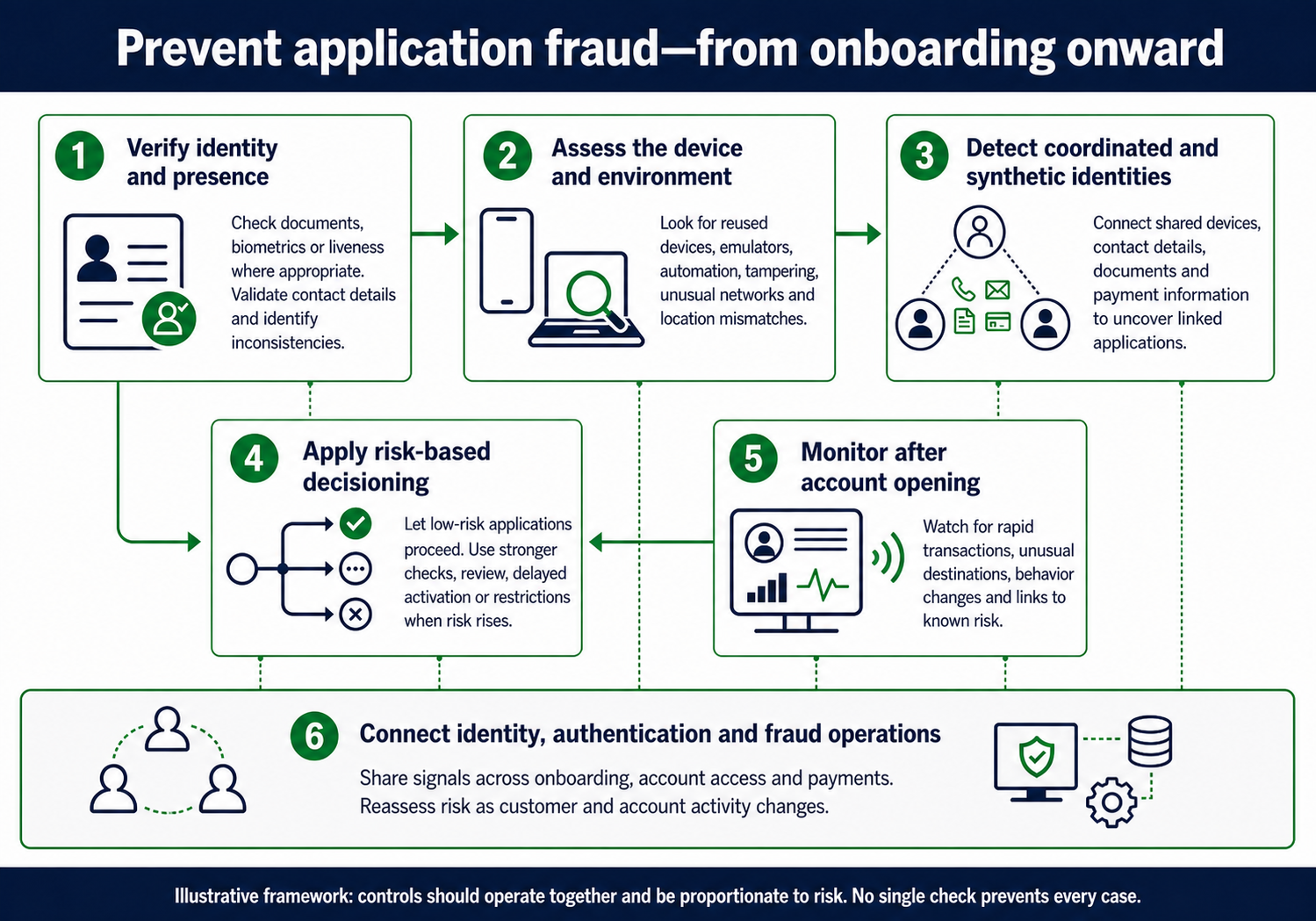
Read the graphic’s text explanation
1. Verify identity and presence
Identity verification should establish more than whether submitted data matches a database. Depending on the product and risk, controls may include document verification, biometric or facial comparison, liveness checks, address and phone validation, and checks for inconsistencies across submitted information.
2. Assess the device and digital environment
Device and network intelligence can identify signals that are difficult to see in application data alone. Examples include device reuse across apparently unrelated applicants, emulators, automation, tampering, unusual IP characteristics, and geographic inconsistencies.
3. Detect coordination and synthetic patterns
Fraud rings rarely behave like independent applicants. Link analysis can reveal shared devices, addresses, phone numbers, payment instruments, document images, email patterns, or transaction destinations. These relationships can expose synthetic identities and coordinated account-opening activity.
4. Use risk-based decisioning
Not every applicant needs the same journey. Low-risk applications can proceed with minimal friction. Higher-risk applications can trigger stronger verification, manual review, delayed activation, restricted functionality, or additional monitoring. This approach helps institutions make the challenge proportional to the risk.
5. Continue monitoring after account opening
Account-opening controls are necessary but not sufficient. Some fraudsters deliberately make an account appear legitimate before exploiting it. Monitor newly opened accounts for rapid transactions, unusual payment destinations, sudden changes in behavior, high chargeback or rejection rates, and links to previously identified risk.
6. Connect identity, authentication, and fraud operations
Fraud signals should not remain isolated in separate systems. A change in device, login behavior, beneficiary, payment pattern, or contact information can alter the risk of an account that looked acceptable during onboarding. Cross-channel risk intelligence supports more consistent decisions from application through account access and payment.
For related account-access risks, The top 3 fraud tactics that lead to account takeovers and how to stop them examines threats that institutions should consider beyond onboarding.
Application fraud and authentication
Application fraud targets applications for new accounts or credit, whether the applicant is new to the institution or already a customer. Authentication alone cannot establish whether the application information is truthful or the identity is being used legitimately. Application-fraud prevention must also ask whether the identity is genuine, whether the applicant is present, whether the application is coordinated with others, and whether the emerging account behavior is consistent with the stated profile.
That is why identity verification, device identity, behavioral analytics, risk-based authentication, and ongoing monitoring work best as connected layers. When a new account later performs a high-risk action, contextual signals can help determine whether to allow the action, request stronger proof, or stop it.
For a broader view of how fraud affects digital banking, see Entersekt’s Encyclopedia entry on banking fraud. For the relationship between application fraud and later credit abuse, see bust-out fraud.
Application fraud prevention checklist
- Define ownership: Agree on application-fraud definitions, responsibilities, and escalation paths across fraud, credit, anti-money laundering (AML), and customer operations teams.
- Test evolving threats: Regularly test controls against synthetic identities, automation, deepfakes, and coordinated attacks.
- Measure balanced outcomes: Track fraud losses, approval quality, review rates, false declines, customer drop-off, and time to detection together.
- Govern AI and escalation: Review model explainability, drift, privacy, bias, and performance, with clear routes for human review.
Frequently asked questions
➡️ Is application fraud the same as identity theft?
No. Identity theft is one method of application fraud: a criminal uses another person’s information without permission. Application fraud is the broader activity of using stolen, manipulated, or fabricated information to open an account or obtain credit.
➡️ Is new account fraud the same as synthetic identity fraud?
No. New account fraud describes fraudulent account opening. Synthetic identity fraud describes the creation or use of a fictitious identity, often by combining real and fabricated information. A synthetic identity can be used for new account fraud, but not every new account fraud case uses a synthetic identity.
➡️ Can identity verification prevent all application fraud?
No single control can prevent every case. Identity verification is stronger when combined with device and network intelligence, behavioral analysis, application-linkage analysis, risk-based decisioning, and monitoring after account opening.
➡️ How does AI make application fraud harder to detect?
AI can make fake documents, images, voices, and identities more convincing. It can also automate large numbers of applications and help fraudsters adapt to onboarding controls. Institutions need layered defenses that assess the whole interaction rather than relying on a document or identity match alone.
➡️ How can institutions reduce new account fraud without rejecting genuine customers?
Use risk-based, layered decisioning. Let low-risk applicants move through a simple journey and reserve stronger verification or manual review for applications with meaningful risk signals. Measure fraud prevention and customer conversion together so security does not become an unnecessary barrier to legitimate account opening.
This entry is educational and does not replace legal, regulatory, compliance, or risk-management advice. Requirements vary by jurisdiction, product, and institution.