








Account takeover (ATO) fraud is one of the fastest-growing threats facing banks today. Criminals who gain access to a customer's banking credentials can drain funds, redirect payments, and lock out the real account holder in minutes. The consequences extend far beyond direct financial loss, eroding customer trust and inviting regulatory scrutiny.
This guide explains how account takeover fraud works, the methods attackers use, and the detection and response strategies your institution needs. You will also learn how Entersekt helps banks build layered defenses that stop unauthorized access before damage is done.Key takeaways: account takeover fraud
- Account takeover fraud cost U.S. adults more than $15.6 billion in reported losses in 2024 alone.
- Credential stuffing, phishing, SIM swapping, and social engineering are the primary attack vectors targeting bank accounts.
- Layered defenses combining risk-based monitoring, behavioral analytics, and step-up authentication reduce ATO exposure significantly.
- Entersekt delivers Context Aware™ Authentication that adapts in real time to each transaction's risk level.
- A clear incident response plan with defined roles and rapid fund-recall procedures limits losses after a breach.
What is account takeover fraud in banking?
Account takeover (ATO) fraud occurs when an unauthorized person gains control of a legitimate customer's bank account. The attacker's goal is typically to steal funds, harvest personal data, or use the compromised account as a launchpad for additional fraud.
Once inside, the criminal may change contact details, add new payment beneficiaries, or initiate high-value transfers. Because many payment rails, including wire and real-time payments, settle almost instantly, stolen funds are difficult to recover.
The FBI issued a 2025 alert noting more than 5,100 ATO complaints since January of that year, with losses exceeding $262 million. For banks, costs include direct write-offs, reputational damage, and increased compliance obligations.
Why are banks the primary target for ATO attacks?
Banks sit at the intersection of identity and money movement. A single compromised login gives an attacker access to checking accounts, savings, bill-pay portals, and peer-to-peer payment channels like Zelle, ACH, and wire transfers.
Unlike e-commerce accounts, bank accounts often hold larger balances and connect to faster settlement networks. That means criminals can move significant sums before anyone flags the activity. According to the Federal Reserve Financial Services, ATO reports filed through Suspicious Activity Reports rose more than 36% in 2024 compared to 2023.
Regulatory pressure adds urgency. Financial institutions face examination standards from the FFIEC that call for multi-factor authentication on high-risk transactions. Failing to meet those standards can result in enforcement actions and increased liability.
How does account takeover fraud work?
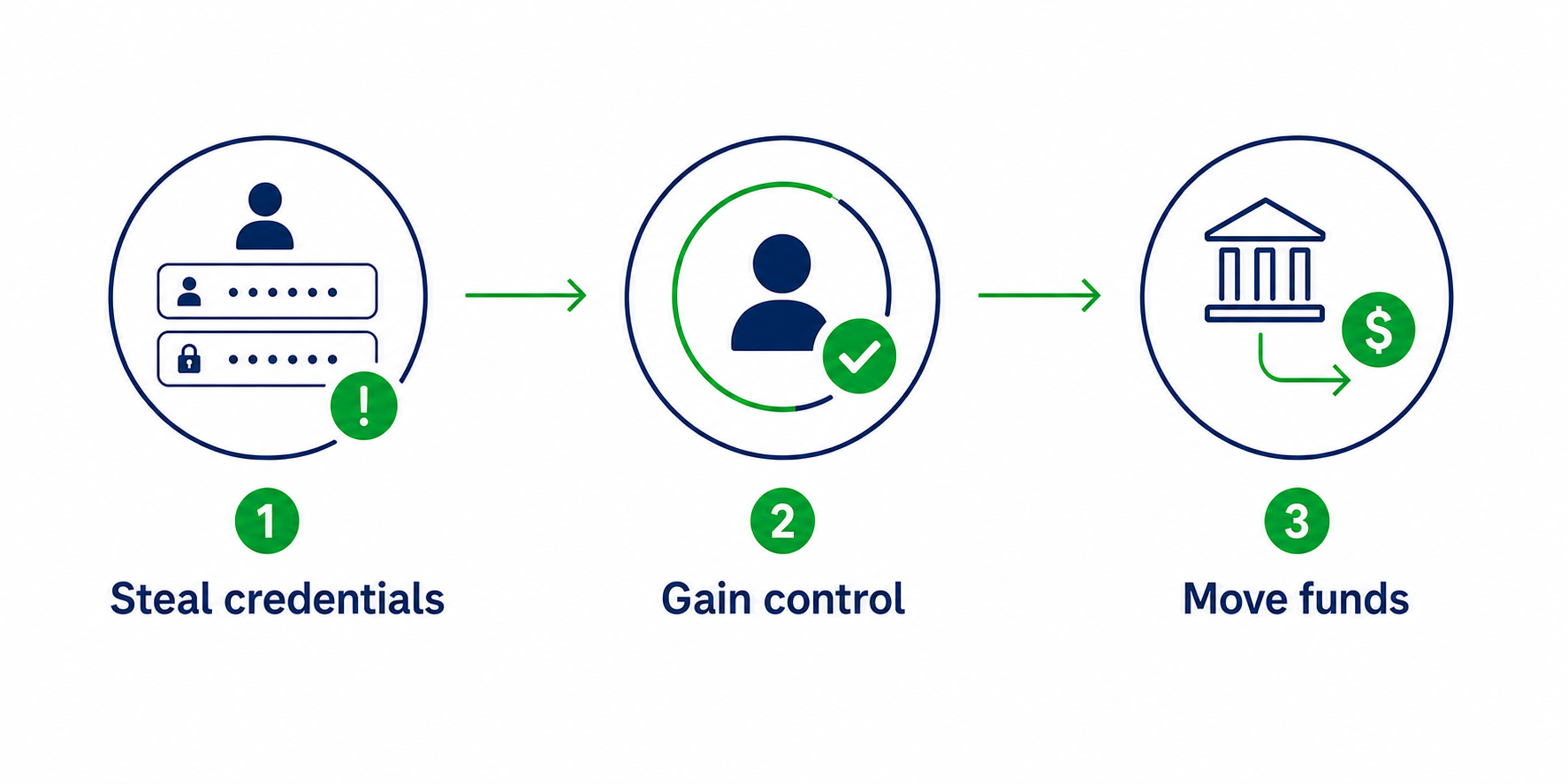
ATO attacks generally follow a three-stage pattern. First, the criminal acquires valid credentials. Second, they make small, non-monetary changes to the account to avoid detection. Third, they execute high-value transactions or lock the real owner out.
The initial credential theft can happen through phishing, social engineering, data breaches, or malware. Social engineering tactics manipulate customers into revealing sensitive information, making multi-factor authentication a key defense against social engineering attacks. By requiring more than one factor to verify a customer's identity, MFA adds protection beyond compromised credentials. Attackers then test stolen credentials against banking portals, often using automated tools that mimic human behavior to avoid triggering bot-detection systems.
Once authenticated, the attacker may change the email address or phone number tied to the account. This ensures that security alerts and step-up challenges are routed to a device the criminal controls, not the legitimate account holder.
Stage 1: Credential acquisition
Criminals obtain login details through several channels. Phishing emails and text messages direct customers to fake banking sites designed to harvest usernames and authentication codes. In other cases, attackers purchase stolen credential sets from dark-web marketplaces.
A tactic the FBI flagged in its 2025 alert involves search engine optimization poisoning. Criminals buy advertisements that mimic legitimate bank ads. Customers searching for their bank's website click on these sponsored results and land on a convincing phishing page.
Stage 2: Account reconnaissance
After gaining access, attackers avoid large transactions at first. They update personal details, add new devices, or request replacement payment cards. These changes are non-monetary and often considered routine, making them harder to flag.
This stage is where real-time risk intelligence becomes critical. If your monitoring systems can detect a sudden change to contact details followed by a new device registration, you can trigger a step-up challenge before any funds leave the account.
Stage 3: Financial exploitation
With full control, the criminal initiates wire transfers, ACH payments, or peer-to-peer transactions to accounts they control. In many cases, funds are converted to cryptocurrency almost immediately, making recovery nearly impossible.
Speed is everything during this stage. Banks that have automated alert systems and pre-configured hold rules in place can intercept suspicious transfers before they clear settlement.
Common attack methods used in ATO fraud
These four attack methods exploit different weaknesses. The comparison below summarizes how each works and the controls that help reduce exposure.
| Method | How it works | Controls that help reduce risk |
|---|---|---|
| Credential stuffing | Automated tools test stolen username-and-password pairs against banking login pages, exploiting credential reuse. | Layer bot detection and rate limiting with device intelligence, behavioral monitoring, and risk-based step-up authentication. |
| Phishing | Fraudulent emails, texts, calls, or websites impersonate trusted organizations to capture credentials and authentication codes. | Use phishing-resistant FIDO authentication alongside customer education and monitoring for suspicious session activity. |
| Sim-swap fraud | Criminals transfer a customer's phone number to a device they control to receive SMS authentication codes. | Reduce reliance on SMS codes. Use device-bound cryptographic authentication or FIDO-based security keys, and verify device-registration changes. |
| Social engineering fraud | Attackers manipulate customers or employees into disclosing sensitive information or approving fraudulent actions. | Combine customer and staff training with independent verification of high-risk requests and monitoring for unusual account changes or payments. |
How to detect account takeover fraud early
Behavioral anomaly monitoring
Behavioral analytics track how each customer typically interacts with your digital channels. As part of risk-based authentication that combines behavioral signals and device identity, these patterns help banks assess whether an interaction is consistent with the customer's usual activity. Typing speed, navigation patterns, session duration, and transaction timing all form a behavioral baseline. When an attacker logs in, their interaction patterns often diverge from that baseline.
Deviations can trigger risk scores that escalate automatically. For instance, if a normally desktop-based user suddenly logs in from a mobile device in a different country and immediately requests a large wire, the system flags the session for additional verification.
Device and session intelligence
Recognizing trusted devices is a key layer in ATO detection. When a customer logs in from a device your system has seen before, risk is lower. A new or unfamiliar device, especially when combined with other anomalies, warrants heightened scrutiny.
Session intelligence extends this by evaluating characteristics like IP geolocation, network type, and browser configuration. These signals, when layered on top of context-aware authentication, build a detailed risk profile for every login attempt.
Transaction pattern analysis
Monitoring for unusual transaction patterns catches ATO activity that occurs after the initial login. Indicators include a sudden spike in transfer volume, payments to first-time beneficiaries, or changes to payment limits that fall outside a customer's normal behavior.
Automated rules that flag these patterns and place temporary holds on suspicious transactions give your fraud team time to investigate before settlement completes.
Beyond detection: How to prevent ATO attacks
Implement adaptive, risk-based authentication
Static authentication policies apply the same level of verification to every login, regardless of risk. A risk-based approach, by contrast, adjusts requirements in real time based on device, location, transaction type, and behavioral signals.
Moving beyond static authentication gives banks the context to strengthen security without adding unnecessary friction for legitimate customers.
Low-risk actions like checking a balance from a recognized device might require no additional verification. High-risk actions like initiating a cross-border wire from a new device trigger step-up challenges, such as a biometric scan or a push notification to a trusted device.
This is why continuous authentication and risk assessment matter. Javelin’s 2025 research on account takeover recommends authenticating customers throughout the session, rather than relying only on the initial login.
The stakes extend beyond financial loss. Its analysis found that U.S. consumers lost almost $16 billion to ATO fraud in 2024, while 42% of victims closed the accounts where the fraud occurred.
Entersekt's digital banking fraud prevention approach applies this adaptive model across all channels. Authentication Advisor dynamically selects the right authentication method based on real-time risk assessments, reducing the chance that a compromised credential alone is enough to complete a transaction.
Deploy phishing-resistant authentication factors
SMS-based one-time codes are vulnerable to SIM swapping and phishing-site interception. Moving to phishing-resistant factors, such as FIDO biometrics, device-bound cryptographic keys, and passwordless authentication, removes these attack surfaces.
Cryptographic key pairs tied to a specific device cannot be intercepted by a phishing page or transferred via a SIM swap. When a customer authenticates with a fingerprint or facial scan on their registered device, the verification is bound to that hardware and cannot be replayed.
Enable out-of-band verification for high-risk actions
Out-of-band verification sends approval requests through a separate channel from the one used to initiate the transaction. If a customer requests a large wire through online banking, a push notification arrives on their registered mobile device asking them to confirm or deny the action.
This approach ensures that even if an attacker controls the web session, they cannot approve transactions without access to the customer's physical device. Entersekt's out-of-band authentication preserves an audit trail showing who approved each action, when, and through what method.
Educate customers and staff on social engineering
Technology alone cannot stop all ATO attempts. Your customers and employees are the last line of defense when attackers use social engineering tactics. Regular training should cover how to recognize phishing messages, what to do when contacted by someone claiming to be bank staff, and why credentials should never be shared over the phone.
Tellers and call-center representatives need role-specific training on ATO red flags, such as customers who appear to be under duress or who are being coached during a call. Internal verification protocols for wire transfers and account changes add another layer of protection.
How to respond to an account takeover incident
Step 1: Contain the breach immediately
The moment your monitoring system or a customer reports suspected ATO, lock the affected account. Disable remote access, revoke active sessions, and block pending transactions that have not yet settled.
Speed matters more here than anywhere else in the response process. For wire transfers, your team has minutes, not hours, to contact the receiving institution and request a recall. Having pre-established relationships and communication protocols with correspondent banks accelerates this step.
Step 2: Reset credentials and secure the account
Force a reset on all credentials tied to the compromised account, including login details, security questions, and any linked authentication factors. If the attacker enrolled their own device, remove it and require the customer to re-verify their identity through an in-person or video-based channel.
Check for secondary damage. Did the attacker change the customer's email address or phone number? Were other accounts at your institution linked to the compromised credentials? A thorough review prevents follow-on attacks.
Step 3: Investigate and document the attack
Conduct a forensic review to establish how the attacker gained access, whether through credential stuffing, phishing, or social engineering. Investigate whether the customer was also manipulated into authorizing fraudulent transactions, since verifying identity alone does not establish that a payment is legitimate. Understanding how social engineering is changing fraud prevention for banks and credit unions helps your team address both compromised access and customer manipulation. Use these findings to close security gaps and strengthen preventive controls.
Document every step of the incident, from initial detection through resolution. This record supports regulatory reporting requirements, including SAR filings with FinCEN, and gives your fraud team data to improve future response times.
Step 4: Notify the customer and regulatory bodies
Contact the affected customer promptly with clear information about what happened, what actions you have taken, and what steps they should take to protect other accounts. Transparency during this process is critical for retaining trust.
File the required Suspicious Activity Report and, if wire fraud is involved, submit a complaint to the FBI's Internet Crime Complaint Center at ic3.gov. Include the words "Account Takeover" in the incident description to help federal investigators track and analyze the trend.
Building a long-term ATO fraud prevention strategy
Adopt a layered security approach
No single control stops every ATO attempt. A layered approach combines perimeter defenses, such as bot detection and rate limiting, with session-level monitoring, behavioral analytics, and adaptive authentication at the transaction level.
Each layer addresses a different stage of the attack chain. Bot detection and credential-screening rules filter out automated attacks at the front door. Behavioral analytics catch anomalies after login. Step-up authentication blocks high-risk transactions before settlement.
Integrate authentication and fraud systems
When your authentication platform and fraud-monitoring system share data in real time, you get a unified view of risk. If fraud monitoring detects rising disputes or unusual ACH returns tied to specific accounts, that signal can tighten authentication requirements for those accounts automatically.
Entersekt's platform connects authentication decisions with risk intelligence across digital banking and payment channels. This integration means your defense adapts in real time instead of reacting after the fact.
Conduct regular fraud simulations and audits
Testing your ATO defenses through red-team exercises and tabletop simulations reveals gaps before attackers find them. Simulate credential-stuffing attacks, phishing campaigns, and SIM-swap scenarios to evaluate how your systems and teams respond under pressure.
Post-exercise audits should benchmark response times against industry standards and identify specific areas for improvement. Regular testing keeps your defenses calibrated to the current threat environment.
In conclusion: Defend your bank against account takeover fraud
Account takeover fraud is accelerating, and the attackers are getting more sophisticated. Banks that rely on static defenses and single-factor controls face increasing losses and regulatory exposure.
The path forward is layered, adaptive, and data-driven. Combine risk-based authentication with behavioral monitoring, phishing-resistant credentials, and a clear incident response plan. Train your teams, educate your customers, and audit your defenses regularly.
Entersekt gives you the authentication technology to build this defense across every channel. To see how Context Aware™ Authentication, bank-grade security, and real-time risk intelligence work together to stop ATO, book a personalized demo today.