







A nonce is a value intended to be used once, or for one specific protocol exchange. In authentication and cryptography, a nonce helps prove that a message or response is fresh rather than copied from an earlier interaction. This makes it harder for an attacker to capture a valid response and reuse it later.
Entersekt applies authentication in the wider context of digital banking, payments, device signals, and transaction risk. Understanding the nonce helps explain one part of how modern authentication systems bind a response to the session, request, device, or transaction that produced it.
What is a nonce?
A nonce is a unique or unpredictable value generated for a particular exchange and checked when the corresponding response arrives. The term comes from “number used once,” although a nonce does not always have to be numeric.
A nonce is usually random, unpredictable, or both. The required properties depend on the protocol. In OpenID Connect, the nonce is a case-sensitive string that links a client session to an ID Token and helps mitigate replay attacks. In TLS, random values and per-record nonces contribute to the uniqueness and integrity of protected communications.
| Property | Why it matters |
|---|---|
| Freshness | Shows that a response relates to the current request or session. |
| Unpredictability | Makes it difficult for an attacker to guess an acceptable value in advance. |
| Uniqueness | Reduces the chance that one valid exchange can be confused with another. |
| Validation | Allows the receiving system to reject a response with a missing or incorrect value. |
How does a nonce work in authentication?
A nonce works by creating a binding between a request and its expected response. The relying party generates a value, stores or associates it with the current session, and sends it as part of an authentication request. The identity provider or authenticator returns the value in a signed or otherwise protected response.
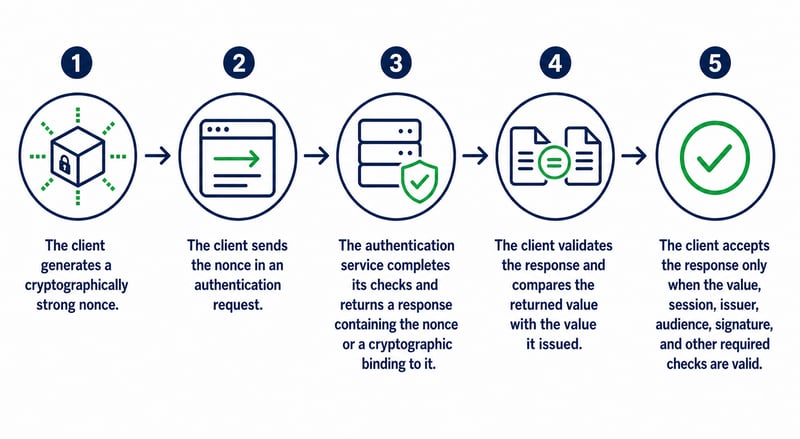
A mismatch is significant. It can indicate that the response belongs to another session, has been altered, has expired, or has been replayed from an earlier exchange.
Why do nonces help prevent replay attacks?
Nonces help prevent replay attacks by making an old response unusable in a new exchange. A captured response normally contains the nonce from the earlier request. When the attacker replays it against a different session, the receiving system expects a different value and rejects the response.
The protection depends on correct implementation. A nonce that is predictable, reused too broadly, accepted without comparison, or stored for too long can weaken the binding. Nonce checks also do not replace signature validation, transport security, audience checks, expiration checks, or transaction integrity controls.
Replay protection must match the action being protected. For a login response, the system may bind the nonce to a client session. For a payment or transfer approval, the cryptographic exchange should also bind the approval to the intended transaction details, account, amount, recipient, or other relevant context.
What is the difference between a nonce and a challenge?
A nonce and a challenge are closely related, but the terms describe different aspects of a protocol value. A nonce highlights single use, freshness, or uniqueness. A challenge highlights the request that the other party must answer or sign.
Many protocols use a random challenge as a nonce. WebAuthn, for example, requires the relying party to generate a random challenge and verify that the returned client data contains the expected challenge. The authenticator signs data that includes the challenge, the requesting origin, and authenticator data.
The distinction is useful when reviewing designs. A challenge can ask an authenticator to demonstrate control of a credential. A nonce can bind the resulting response to the exchange that created it. In practice, one value can serve both roles when the protocol defines it that way.
How is a nonce used in OpenID Connect?
OpenID Connect uses the nonce request parameter to associate a client session with an ID Token and to mitigate replay attacks. The client sends the nonce in the Authentication Request, and the authorization server passes it into the ID Token when the parameter is present.
The client must compare the nonce Claim in the ID Token with the nonce it sent. OpenID Connect also calls for sufficient entropy so that attackers cannot guess valid values. The protocol notes that a web server client can store a random value in an HttpOnly session cookie and send a cryptographic hash of that value as the nonce.
The nonce check is one part of ID Token validation. The client must also validate the issuer, audience, signature, expiration, and other requirements defined by the selected flow. A correct nonce does not make an otherwise invalid token trustworthy.
How is a nonce used in WebAuthn?
WebAuthn uses the related concept of a server-generated challenge to bind an authentication assertion to a particular ceremony. During authentication, the relying party sends a challenge to the client. The authenticator signs data that includes the challenge, and the relying party verifies that the returned challenge matches the one it generated.
The W3C WebAuthn specification states that relying parties must generate challenges in a trusted environment, store them temporarily until the operation is complete, and reject a response when the returned challenge does not match. It also states that challenges need enough entropy to make guessing infeasible.
WebAuthn adds further bindings. The assertion includes data associated with the relying party identifier and the request origin. The relying party verifies the signature with the credential public key registered for the account. These checks help prevent an assertion created for one site or ceremony from being accepted in another context.
Entersekt’s passkey resources explain how FIDO and WebAuthn support cryptographic authentication with credentials managed by a user’s device. A nonce or challenge is one component of that larger trust model.
How is a nonce used in TLS and encryption?
In authenticated encryption, a nonce is an input that helps ensure that encrypting different messages does not produce unsafe reuse of the same cryptographic state. The exact requirements depend on the algorithm and protocol.
TLS 1.3 derives each record nonce from a per-connection initialization value and a record sequence number. The sequence number advances for each record and resets when traffic keys change. The resulting nonce is used by the authenticated encryption algorithm to protect the record.
Nonce reuse can have serious consequences for some encryption modes. Implementers must follow the requirements of the selected algorithm and protocol rather than treating a nonce as a general-purpose secret. A nonce may be visible on the wire in some designs. Its security role comes from uniqueness, correct binding, and correct use with the key and algorithm.
What are the security requirements for nonce generation?
Secure nonce generation begins with a cryptographically secure random number generator when unpredictability is required. The value should have enough entropy for the threat model and should be generated in a trusted part of the system.
- Use a cryptographic random source. Do not generate security-sensitive values with predictable counters, timestamps, usernames, or ordinary pseudo-random functions.
- Set an appropriate lifetime. Keep the value available long enough to validate the response, then retire it.
- Bind it to the correct context. Associate the value with the client, session, issuer, origin, request, or transaction it protects.
- Compare it correctly. Treat nonce values as protocol-defined, case-sensitive or binary values when required.
- Reject missing or unexpected values. A system should not silently continue when a required nonce is absent or does not match.
- Prevent cross-context reuse. A value issued for one client, account, origin, or transaction should not be accepted in another context.
Distributed systems need particular care. A nonce may be generated by one service and validated by another, so the architecture must preserve the necessary state or use a protected design that lets the verifier confirm the binding. Clock synchronization, retry behavior, caching, and failover can all affect replay protection.
What are the limits of nonce protection?
A nonce reduces replay risk, but it does not authenticate a person by itself. It does not prove that the response came from a trusted issuer unless the response is signed or protected by another authenticated mechanism.
A nonce also does not establish transaction intent on its own. A customer may approve a request after being deceived by a scammer. Financial institutions therefore need controls that examine the transaction context, channel, device, behavior, and risk signals alongside authentication.
Entersekt’s Context Aware Authentication approach connects authentication decisions with transaction context and risk signals. Its role is broader than nonce validation: it helps determine when an interaction should pass silently and when a higher-assurance control is appropriate.
How does nonce validation support financial services security?
Nonce validation helps financial institutions bind digital authentication responses to the specific login, payment, or account action that initiated them. That binding can reduce the value of captured protocol messages and strengthen the evidence supporting an authentication decision.
For online banking and payments, the control should sit alongside device binding, cryptographic signatures, risk assessment, transaction signing, and channel protection. Entersekt’s digital account authentication covers authentication across channels and use cases, including account access, money movement, and high-risk interactions.
For browser-based journeys, Browser Authentication connects browser identity, FIDO2 capabilities, device binding, and risk signals. These controls address different parts of the problem. The nonce supports freshness, while broader authentication and fraud controls establish who is acting and whether the requested action is appropriate.
Related concepts
- Replay attack: Reuse of a previously captured valid message or response.
- Challenge-response authentication: A protocol in which one party issues a challenge and the other returns a valid response.
- Session binding: Linking a response or credential to a particular client session.
- Transaction signing: Applying a cryptographic signature to transaction details so the approval is tied to the intended action.
- Cryptographic random number generator: A random source designed for security-sensitive values.
- Passkey: A FIDO credential that uses public key cryptography for sign-in and authentication.
FAQs about nonce
➡️ Is a nonce the same as a one-time code?
No. A nonce is a protocol value used to bind messages or responses to a particular exchange. A one-time code is usually entered or read by a person as proof of access to a channel. A nonce may never be shown to the customer and may be checked entirely by software.
➡️ Should a nonce be secret?
A nonce does not always need to be secret. In several protocols, its security depends on unpredictability, uniqueness, and correct validation rather than confidentiality. Implementers should follow the protocol requirements and protect any associated session state or secret used to derive the nonce.
➡️ What happens when a nonce does not match?
A nonce mismatch should cause the authentication response to fail validation. It can indicate a replayed response, a response from another session, altered data, incorrect state handling, or an implementation error. The system should not accept the identity or action until the failure is handled according to security policy.
➡️ Can a nonce stop phishing?
A nonce can block some replay and token substitution scenarios, but it cannot stop every phishing or social engineering attack. Strong protection combines nonce validation with origin checks, signed responses, phishing-resistant credentials, transaction context, device signals, and risk-aware authentication. Entersekt connects these controls across digital banking journeys.