
Fraudsters are not sitting around idly waiting for new fraud opportunities to present themselves. Their scams are sophisticated, and their criminal operations industrialized.
The Federal Trade Commission reported that $12.5 billion was lost to fraud in 2024. What’s more, a staggering 70% of American adults fell victim to scams in 2025, The Global Anti-Scam Alliance (GASA) revealed in their State of Scams in the United States of America 2025 report. Even more concerning, GASA adds that the “average American now encounters a scam attempt every single day – 377 times per year.”
Though not new, social engineering scams are still one of the biggest threats facing financial institutions (FIs) today. But with advanced risk intelligence, banks, merchants, and issuers can detect the often-unseen signals of manipulation, protecting customers from devastating losses — and turning fraud resilience into a competitive edge.
Here’s how.
The Federal Trade Commission reported that $12.5 billion was lost to fraud in 2024. What’s more, a staggering 70% of American adults fell victim to scams in 2025, The Global Anti-Scam Alliance (GASA) revealed in their State of Scams in the United States of America 2025 report. Even more concerning, GASA adds that the “average American now encounters a scam attempt every single day – 377 times per year.”
Though not new, social engineering scams are still one of the biggest threats facing financial institutions (FIs) today. But with advanced risk intelligence, banks, merchants, and issuers can detect the often-unseen signals of manipulation, protecting customers from devastating losses — and turning fraud resilience into a competitive edge.
Here’s how.
Dynamic, real-time fraud risk prevention
With the help of AI, fraudsters have evolved their tactics to become far more targeted. While they do often still employ a “catch all” approach in some instances, often attacks are customized to individual victims. Solutions employing dynamic risk intelligence continuously learn from new risk conditions and refine their risk assessment, extending safeguards beyond merely verifying who is transacting, but also why.
Take the scenario of the U.S. government putting an end to paper check disbursements from the end of September 2025. Millions of federal payments — from benefits to vendor disbursements — are moving entirely online. While this modernization promises faster, more convenient access to funds, it also opens the door to a whole new batch of social engineering scams.
Take the scenario of the U.S. government putting an end to paper check disbursements from the end of September 2025. Millions of federal payments — from benefits to vendor disbursements — are moving entirely online. While this modernization promises faster, more convenient access to funds, it also opens the door to a whole new batch of social engineering scams.
Real-time risk intelligence can stop these attacks as they unfold. So, if a fraudster attempts to redirect a benefits payment using a newly registered device or unusual IP address, dynamic risk conditions trigger a step-up authentication challenge — verifying the identity of the true account holder before funds are released.
A proactive layer of security can safeguard consumers and institutions as these new types of threats emerge.
A proactive layer of security can safeguard consumers and institutions as these new types of threats emerge.
Improving transaction success and CX with Entersekt’s dynamic RBA
Customers expect strong protection from scams. However, when a transaction is legitimate, they don’t want their provider to decline it. Employing Entersekt’s advanced risk-based authentication (RBA) solution, dynamic risk conditions protect customers when they need protection: in the moment.
By learning from each customer’s transaction history and behavior, the solution provides the agility that customers want. Rather than flagging every ‘risky’ transaction, the system recognizes normal patterns and steps in only when something truly appears suspicious.
The result: smarter fraud detection with less friction for genuine customers.
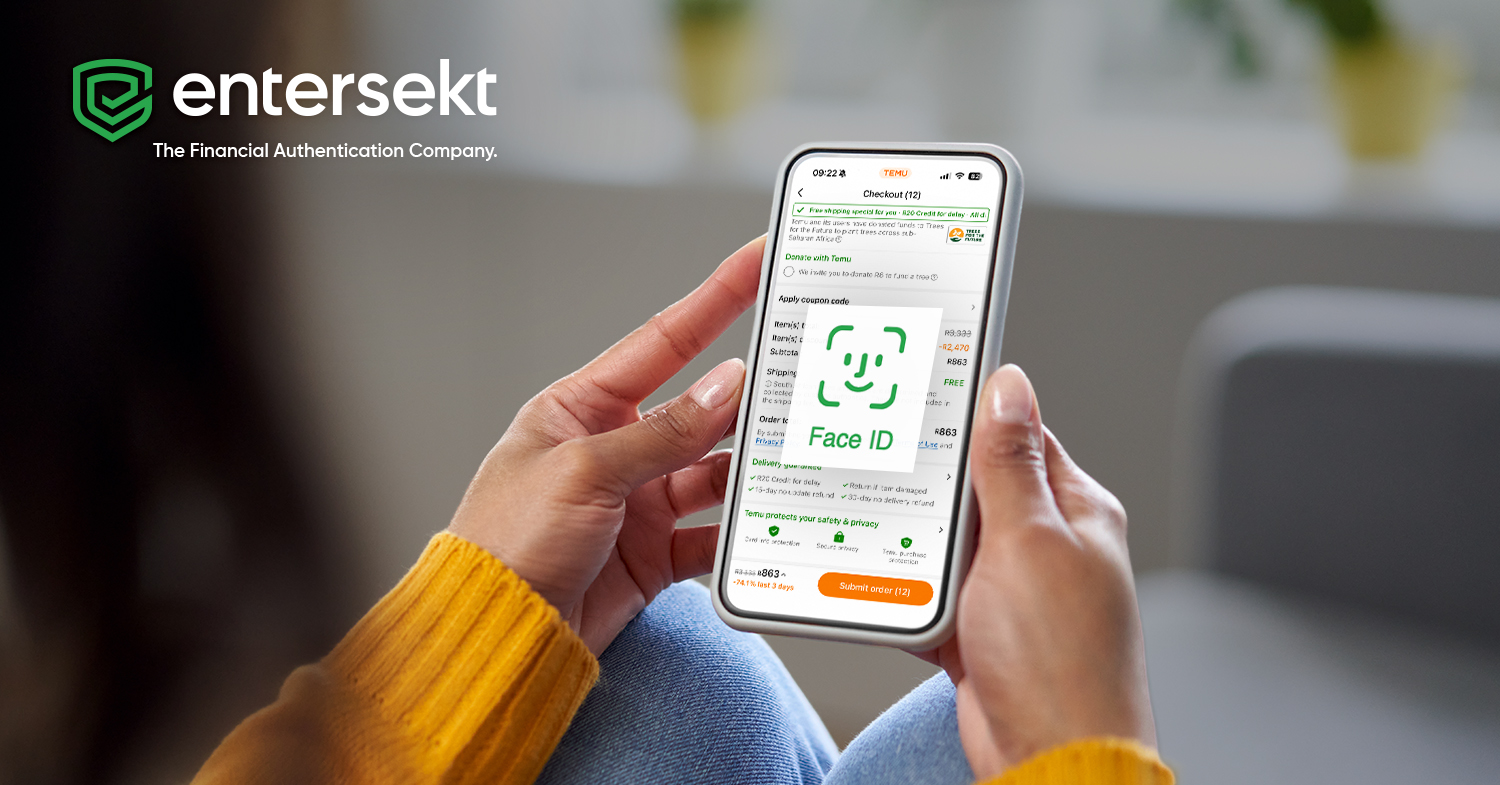
Let’s look at another example. Say a customer is shopping on Temu. If this is a regular occurrence (i.e.: the customer has been shopping on Temu once a month for three consecutive months), behavioral analytics (a core component in dynamic risk-based authentication) would assess the risk as far lower than a customer’s first Temu purchase and allow the transaction to go through without an active challenge.
In this instance, to ensure the customer is still protected from fraud risks, silent authenticators may run in the background to verify their location and device, without requiring any action from the customer. This sophisticated, individualized analysis and response results in effective fraud prevention — striking a much-needed balance between security and optimal customer experience.
By learning from each customer’s transaction history and behavior, the solution provides the agility that customers want. Rather than flagging every ‘risky’ transaction, the system recognizes normal patterns and steps in only when something truly appears suspicious.
The result: smarter fraud detection with less friction for genuine customers.
Let’s look at another example. Say a customer is shopping on Temu. If this is a regular occurrence (i.e.: the customer has been shopping on Temu once a month for three consecutive months), behavioral analytics (a core component in dynamic risk-based authentication) would assess the risk as far lower than a customer’s first Temu purchase and allow the transaction to go through without an active challenge.
In this instance, to ensure the customer is still protected from fraud risks, silent authenticators may run in the background to verify their location and device, without requiring any action from the customer. This sophisticated, individualized analysis and response results in effective fraud prevention — striking a much-needed balance between security and optimal customer experience.
Transitioning from reactive fraud defense to proactive trust and resilience
In today’s digital world, every transaction carries a risk. Especially as fraudsters exploit any changes in the banking and payment ecosystem, along with familiar security gaps. Those that modernize their fraud defenses gain insight beyond who is transacting. They will better understand what the customer is doing and why, interpreting their intent and the context to expose hidden fraud signals.
Solutions, like Entersekt’s dynamic risk–based authentication, can better equip banks to detect coercion, social engineering, and other manipulative tactics.
Resilience comes from anticipating risk, not just responding to it. By turning continuous authentication into a strategic advantage, FIs can protect customers, strengthen loyalty, and futureproof their business.
Solutions, like Entersekt’s dynamic risk–based authentication, can better equip banks to detect coercion, social engineering, and other manipulative tactics.
Resilience comes from anticipating risk, not just responding to it. By turning continuous authentication into a strategic advantage, FIs can protect customers, strengthen loyalty, and futureproof their business.
Learn more about redefining trust with Entersekt’s risk-based intelligence here.

